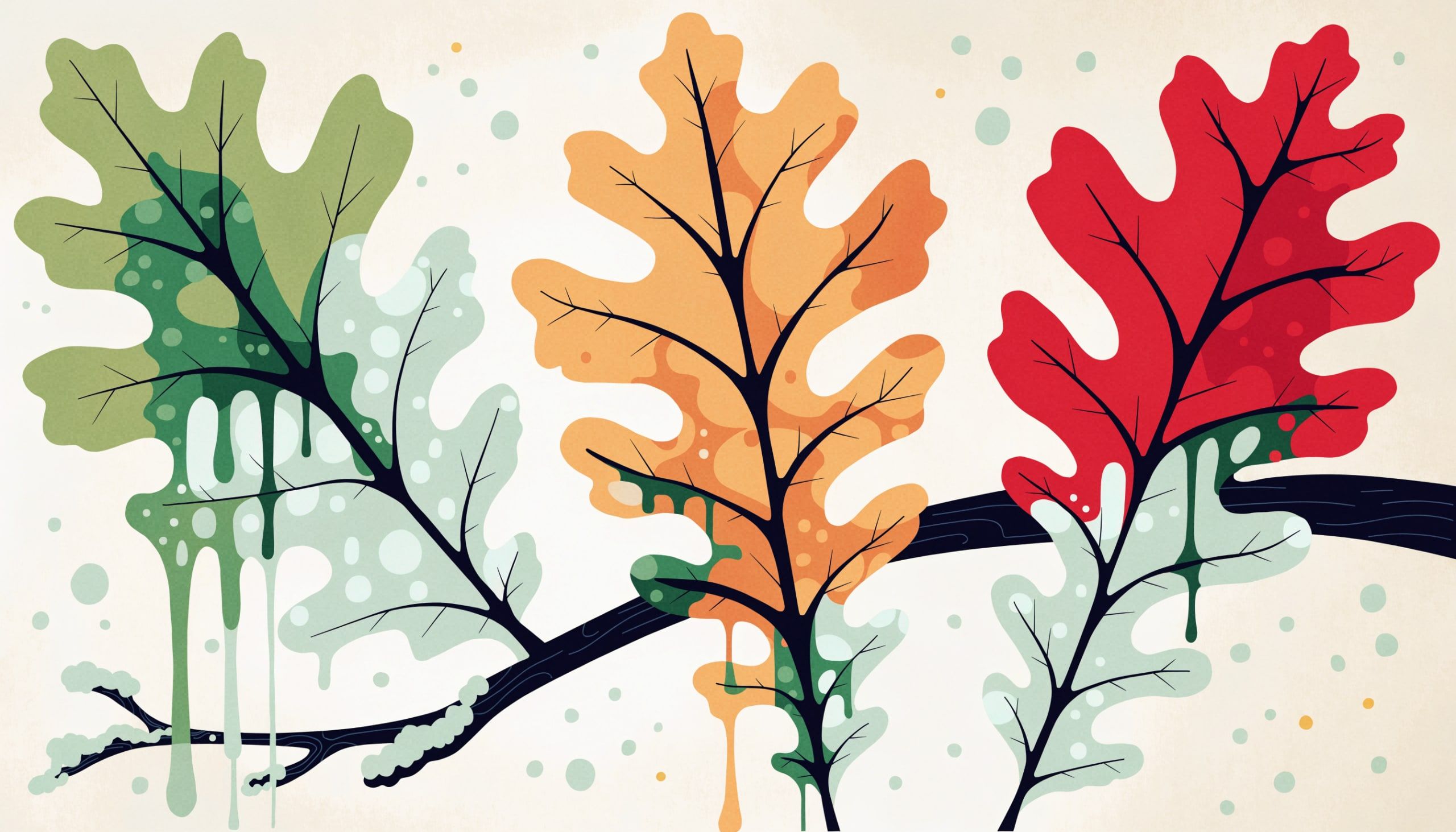
A leaf isn’t green — it’s painted green
A leaf carries several pigments at once. The most abundant, chlorophyll, absorbs red and blue light and bounces back the green we see. But living right beside it are yellows and oranges already in place: the carotenoids, the same pigments that colour carrots and the autumn foliage of a ginkgo. Through summer they’re masked. Chlorophyll is made on a constant loop, and it dominates everything.
Autumn shuts off the tap
When the days shorten and the nights cool, the tree gets a signal: winter is on its way, and the leaves are about to cost more than they return. A thin wall of cells forms at the base of the petiole, ready to release the leaf. Sap flow slows, then stops.
Cut off from its supply, chlorophyll stops being renewed. It breaks down within days, and the green fades. The yellow pigments that had been there since spring are suddenly visible. The leaf hasn’t changed its makeup: it has simply lost what was hiding the rest.
Red, on the other hand, is made on purpose
So the yellows surface through a kind of unveiling. Red is something else entirely: it is built at the very moment the leaf is about to die. Certain species (maples, red oaks, sumacs) actively synthesise red pigments called anthocyanins during autumn. It isn’t a leftover from summer; it’s a fresh production, one that draws on energy at the very moment the tree is winding down.
No one has fully settled what it’s for. The leading hypotheses: shielding the leaf from excess light while it’s still pulling its nutrients back, deterring insects that would lay eggs there, or signalling something to a neighbouring tree whose genome can read it.
That’s why European autumns lean yellow (most of the local species don’t produce anthocyanins) while the forests of Quebec or Vermont catch fire in red: they hold many more trees that build the pigment. It’s the same season; the cast of trees is different.
The world has other ways of turning red, up high, at the hour the day goes out. Why are sunsets red?