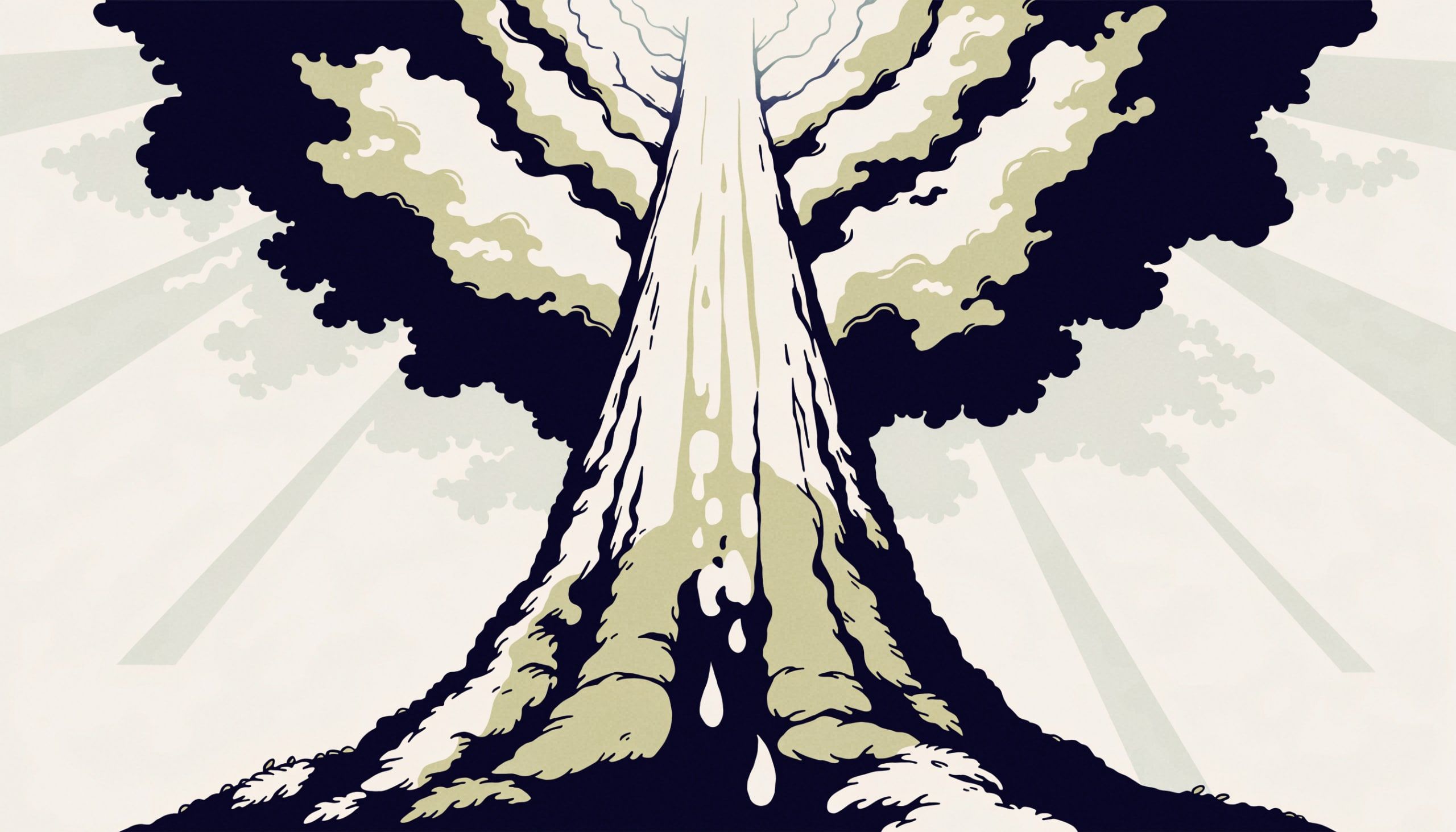
Growing tall means pumping against gravity
A tree has no pump. It moves water from its roots to its leaves through a quietly remarkable trick: as the leaves transpire, they pull on the column of water held in narrow channels, the xylem vessels. That tension travels all the way down to the soil and draws water up, as if the whole tree were a single biological straw.
The taller the tree, the longer the straw. And the longer the straw, the greater the tension at its top. Gravity tugs the water down, the leaves tug it up, and at some point the rope frays.
The water eventually snaps
Above roughly 120 to 130 metres, the internal tension exceeds the cohesion of the liquid itself: air bubbles appear inside the vessels, a phenomenon known as cavitation. A cavitated vessel carries nothing more. The tree loses a vein. At extreme heights, the topmost leaves no longer get enough water; they grow smaller and tougher, like desert leaves. They photosynthesise less than the ones lower down, so they bring back less sugar, so they justify less of the energy spent keeping them alive.
The ceiling isn’t a wall — it’s a slope. Past a certain point, every extra metre costs more than it returns. The tree stops climbing and starts spreading.
The world record: Hyperion, 115 metres
The tallest known tree on Earth is a coast redwood (Sequoia sempervirens) named Hyperion, found in 2006 in northern California. It stands at roughly 115.9 metres, about the height of a 38-storey building. Its exact location is kept secret by park rangers to protect the root zone from being trampled.
Other species press against the same ceiling. The mountain ash of Tasmania (Eucalyptus regnans) and the Douglas firs of the American Pacific Northwest reach close to 100 metres: the tallest living Douglas fir on record stands at 99.82 m. Always around the same limit. Three species, three continents, three climates, no recent evolutionary link, and yet they all hit the same wall.
That isn’t coincidence. It’s the physics of water setting the rule.
Those same crowns, come autumn, change colour before letting go. Why do leaves turn red in autumn?