A question of path, not of sun
The sun hasn’t changed colour between noon and evening. What has changed is the amount of atmosphere its light has to cross to reach you. At its zenith, the light comes down almost vertically and only travels through a thin layer of air. At the horizon, the same light enters sideways and crosses a column of atmosphere up to forty times thicker, along a trajectory that grazes the surface of the Earth.
That longer journey isn’t neutral. The air is full of molecules (mostly nitrogen and oxygen) that interact with the light passing through them. And those molecules have a preference: they scatter short wavelengths (blue, violet) far more than long ones (red, orange).
The scattering that takes the blue out
This phenomenon has a name and a century. It was described in 1871 by the English physicist John William Strutt, the future Lord Rayleigh, who showed that air molecules scatter light according to a very simple law: scattering intensity rises sharply as the wavelength drops: by about a factor of five to ten between blue and red across the visible range.
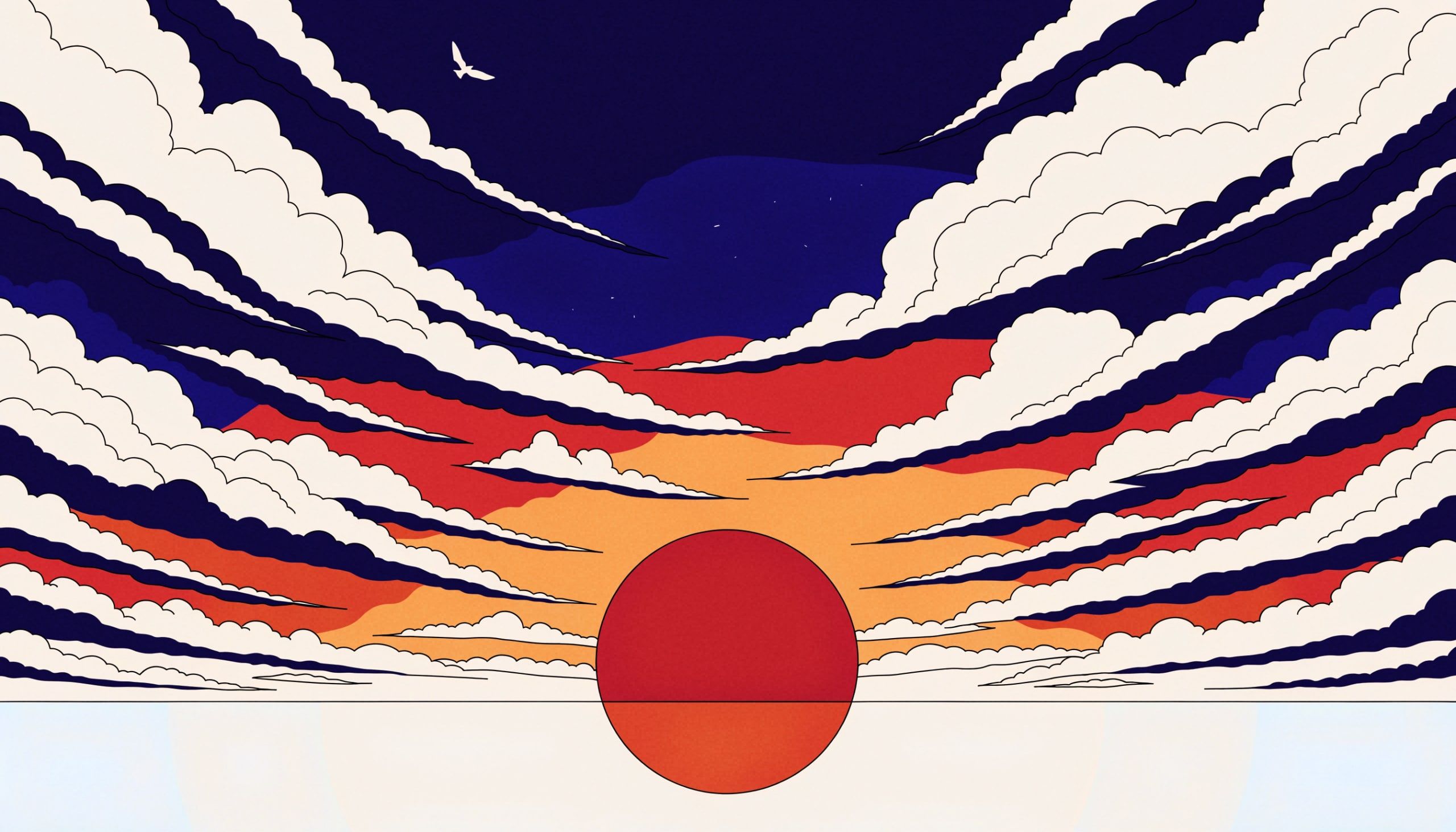
During the day, that blue scattered everywhere in the sky is what makes the sky look blue from anywhere you stand. In the evening, when the sun’s rays come in almost horizontally, the longer path gives the blue time to scatter completely out of your line of sight. It spills above you, sideways, behind. What continues straight to your eyes is what wasn’t scattered: the longer wavelengths, the reds and oranges.
The sunset isn’t redder; it’s just that the blue has already finished its journey.
Why some sunsets turn to fire
If scattering alone explained the colour, every sunset would look the same. They obviously don’t. A clear evening yields a soft orange disc; an evening of volcanic eruption, of forest fires or of dust storms gives blood-red skies that can fill an entire hemisphere.
The reason is suspended particles: dust, ash, sea salt, droplets of water. Those particles are far larger than the air’s molecules, and they scatter light differently, saturating the colours that have already made it through. The thicker the atmospheric load, the narrower the filter, and the more the red takes over.
That’s why the most striking sunsets often follow a climatic event. The 1883 eruption of Krakatoa coloured skies all over the world for years afterwards. What you watch in the evening, then, isn’t only light — it’s the exact state, on that particular day, of the air the light had to cross.
Then the red fades, and the riddle overhead changes colour. Why is the sky dark at night?