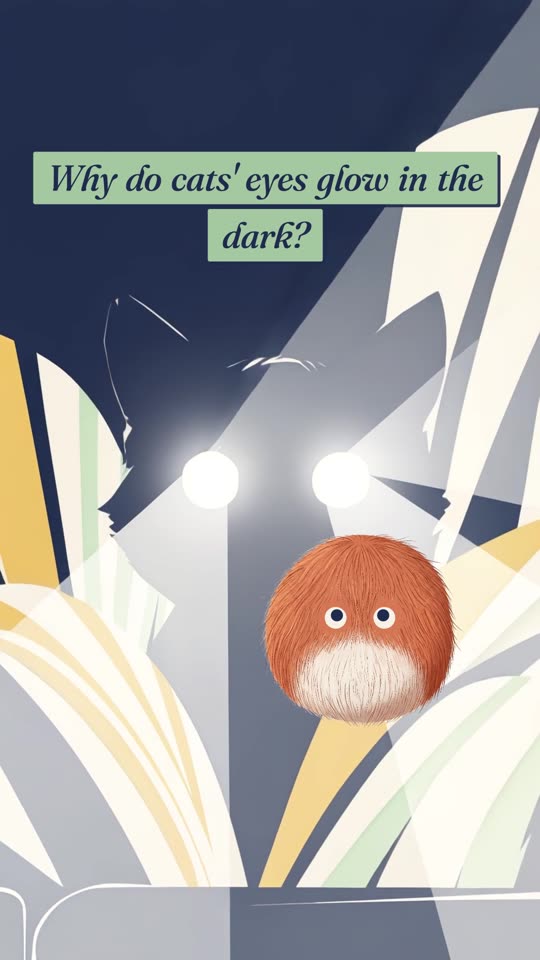

Two points of gold in the gloom
You switch off the living-room light, and two small lamps come on under the sofa. The cat has no hidden battery. Its eyes make no light of their own: they send it back. All the magic sits in a word the cat carries at the back of each eye, the tapetum lucidum, literally “bright carpet”.
This carpet is a thin layer of cells set just behind the retina, the surface that catches images. When a ray crosses the eye, it first strikes that retina. In us, whatever slips through uncaught is lost, swallowed by the dark back of the eye. In the cat, it lands on the mirror.
The mirror that gives a second chance
The tapetum bounces the light forward, back exactly the way it came. So the ray passes the retina a second time, which gets a fresh chance to catch it. It is like re-reading a sentence so as to miss no word.
The result: in a nearly black room, the cat sees where we make out nothing. It needs about six times less light than we do to find its way. And what comes back into our eyes is the surplus of light the retina failed to catch on the second pass. That reflection escapes through the pupil and heads straight for us. There are the two little lamps.
The colour of that glow shifts from one cat to the next: often green, sometimes yellow or bluish. It depends on the carpet’s pigments and the animal’s age. It is also why, in flash photos, the cat picks up green eyes while we inherit red ones. We, with no mirror, only send back the red of our blood vessels.
A mirror for dusk hunters
This carpet is no invention reserved for cats. Dogs have it, cows, deer, deep-sea sharks too. You find it mostly in animals active at dawn and nightfall, when light grows scarce and the prey moves. Hunting in the gloom means wasting no photon.
We humans have none. Our ancestors lived by day, and sharp sight beat sensitive sight. Because the mirror comes at a price: by sending light back, it makes it bounce a little and slightly blurs the image. The cat sees in the dark, but with a faint blur we don’t have.
So next time two golden points fix you from the far end of the garden, remember: it isn’t a gaze lighting up, it’s the night being handed back to you.