The visual trap
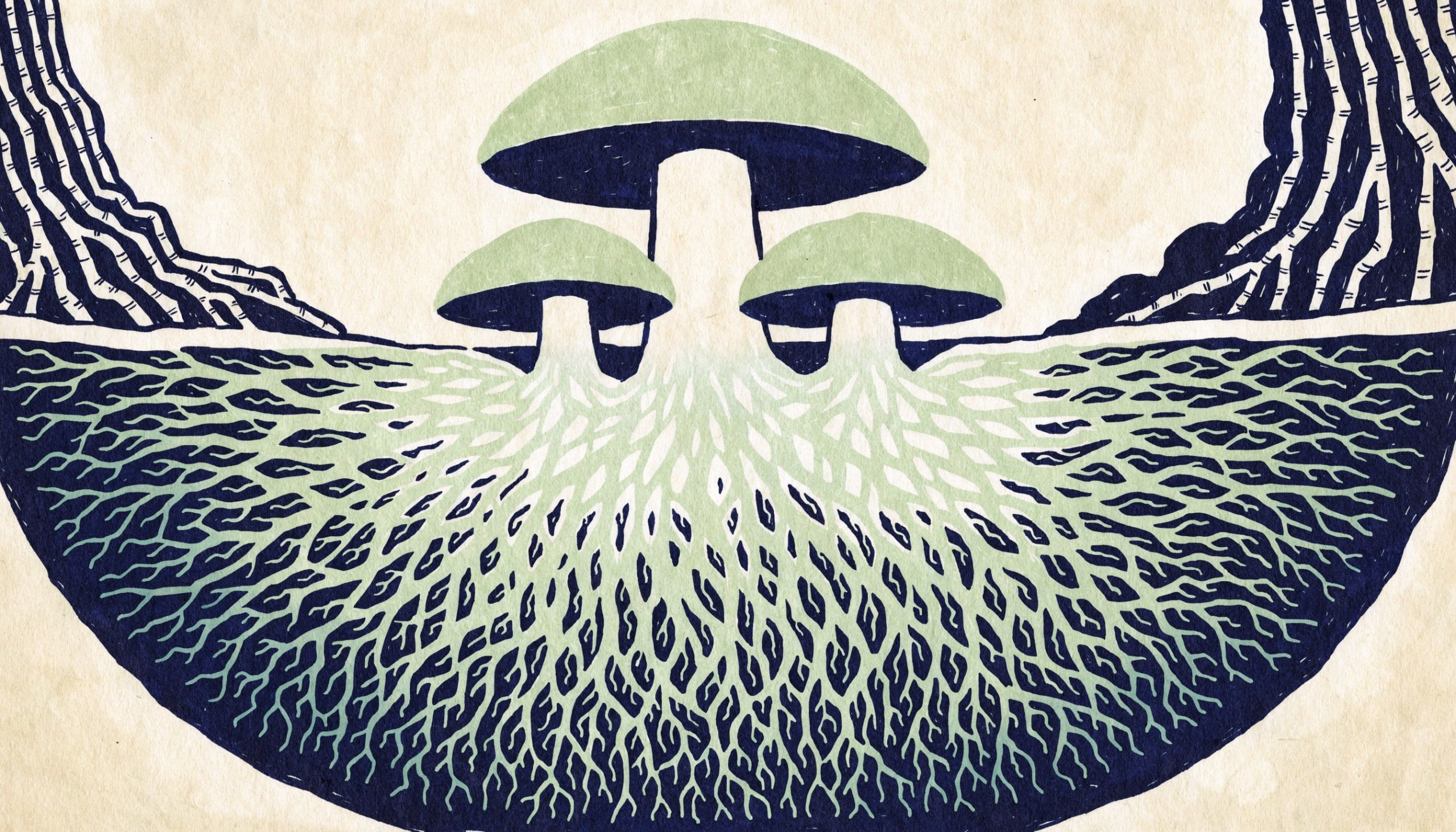
A mushroom grows out of the soil, doesn’t move, and often wears a small stalk with a cap on top. For centuries, instinct filed it away with the plants. But something never quite added up: it has no leaves, and crucially no chlorophyll. It doesn’t catch light, doesn’t build sugar, doesn’t breathe the way a plant does. What we see pushing out of the ground is only its fruit. The real organism is a vast web of filaments (the mycelium) running underground across tens, sometimes thousands of square metres.
The largest known living organism on Earth is a fungus in Oregon, Armillaria ostoyae, sprawling across roughly 965 hectares. It has been there, motionless, for thousands of years.
Their cells give away the family secret
A plant’s cell walls are made of cellulose: the same compound as wood or cotton. A fungus builds its walls from chitin: the material in lobster shells, fly wings, insect exoskeletons. Nothing to do with plants. Everything to do with the animal world.
Feeding works the same way. A plant assembles itself from light and carbon dioxide. A fungus, like us, takes in organic matter that already exists: it digests dead wood, fallen leaves, sometimes living things. It just digests on the outside: its filaments secrete enzymes into the soil, and the fungus then absorbs whatever has been broken down. Animal digestion, turned inside out.
The family tree settled it
In the 1990s, molecular biology compared genes across the three kingdoms. The verdict came as a surprise: fungi and animals share a common ancestor from about a billion years ago. The plants had already branched off long before. Put bluntly:
You are closer to a button mushroom than an apple tree is to a button mushroom.
This kinship has very tangible consequences. It’s why a good antifungal drug is so hard to make: the molecules that kill fungi tend to attack our own cells too, because the inner machinery is too similar. Plants, by contrast, can be hit with herbicides at no risk to us — we share almost nothing with them.
The fungal kingdom isn’t an oversight or a halfway category. It’s a full branch of life, and it’s the one we happen to live next door to.
That animal kinship, you carry it right into your skin, in reflexes your ancestors left you. Why do we get goosebumps?