The internet isn’t in the sky
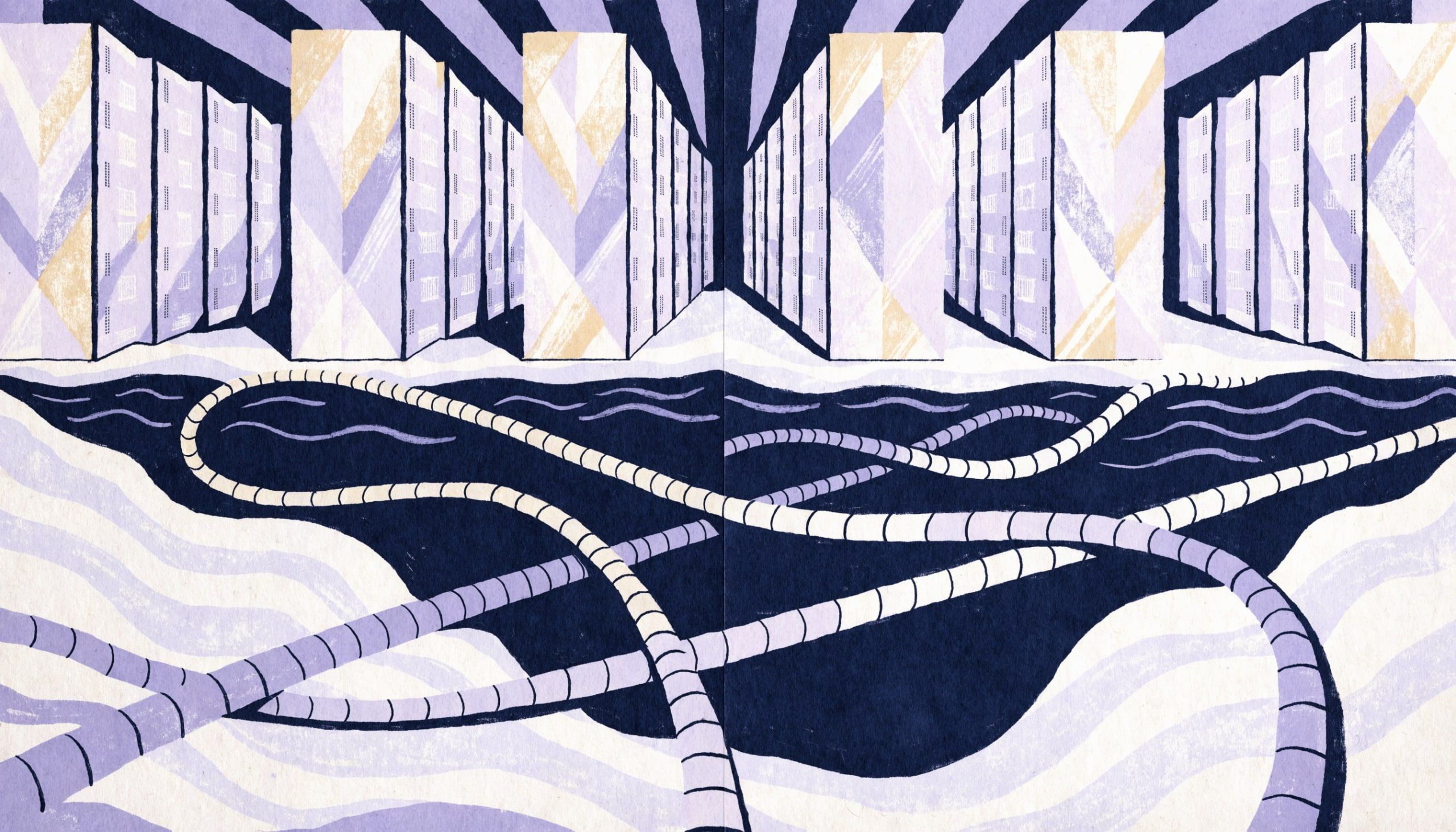
The vocabulary misleads us. We talk about the cloud, about data in the air, about a web that floats overhead. In reality, the internet is entirely physical infrastructure. No bit floats. Every photo you send, every video you watch, every word you read on a screen has travelled through cables, routers, and servers: through reinforced concrete and copper.
The clouds run by Amazon, Microsoft and Google are climate-controlled concrete warehouses that can stretch beyond 50,000 square metres. Inside, tens of thousands of servers sit racked on shelves, lined up in long rows. The biggest ones draw more than 600 megawatts: the electricity demand of a mid-sized city. What you call the cloud is, in fact, a ventilated warehouse somewhere in Oregon, Ireland, or Singapore.
The real internet is on the ocean floor
Here’s where it gets striking: more than 95% of international internet traffic travels through cables on the seafloor. All told, roughly 1.5 million kilometres of submarine cables crisscross the world’s oceans, close to forty times the circumference of the Earth.
Each cable is about as thick as a garden hose. Inside, a handful of optical fibres the width of a human hair carry the entire load. Around them, layer after layer of aluminium, steel wire and polyethylene: armour against pressure, anchors and bites. The cables are laid by specialised ships that pay them out onto the seabed at depths reaching 8,000 metres.
And these cables are vulnerable. Tanker anchors slice them on a regular basis. Deep-sea trawls drag them up. Earthquakes shear them. Sharks have bitten them. Worldwide, there are 150 to 200 breaks each year: about three repairs every week. Each time, a ship has to be sent out to haul the cable back to the surface, splice it after hauling it up from several thousand metres down, and lower it back into the water.
A message travels through an army of machines
When you send a message, you don’t toss it at a recipient. You break it into small numbered packets that leave in parallel. Each packet hops through a series of machines: a router at your internet provider, then another, then an exchange point (IXP), the physical locations where networks meet, then maybe a submarine cable, then more routers on the far side, before reaching a server that puts everything back together.
A single click triggers, on average, around twenty stops across the world. All of it in less than a second, at a speed capped only by light travelling through fibre (about 200,000 km/s in glass, slightly slower than in free space).
So the internet isn’t a place — it’s an agreement. A set of protocols honoured by hundreds of thousands of machines that have chosen to speak to each other. Strip away the physical infrastructure, and nothing is left. Strip away the agreement, and the concrete falls silent.
These machines swap packets without understanding a word of what they carry. Why does a voice assistant struggle to truly understand?