Rain wears the stone down
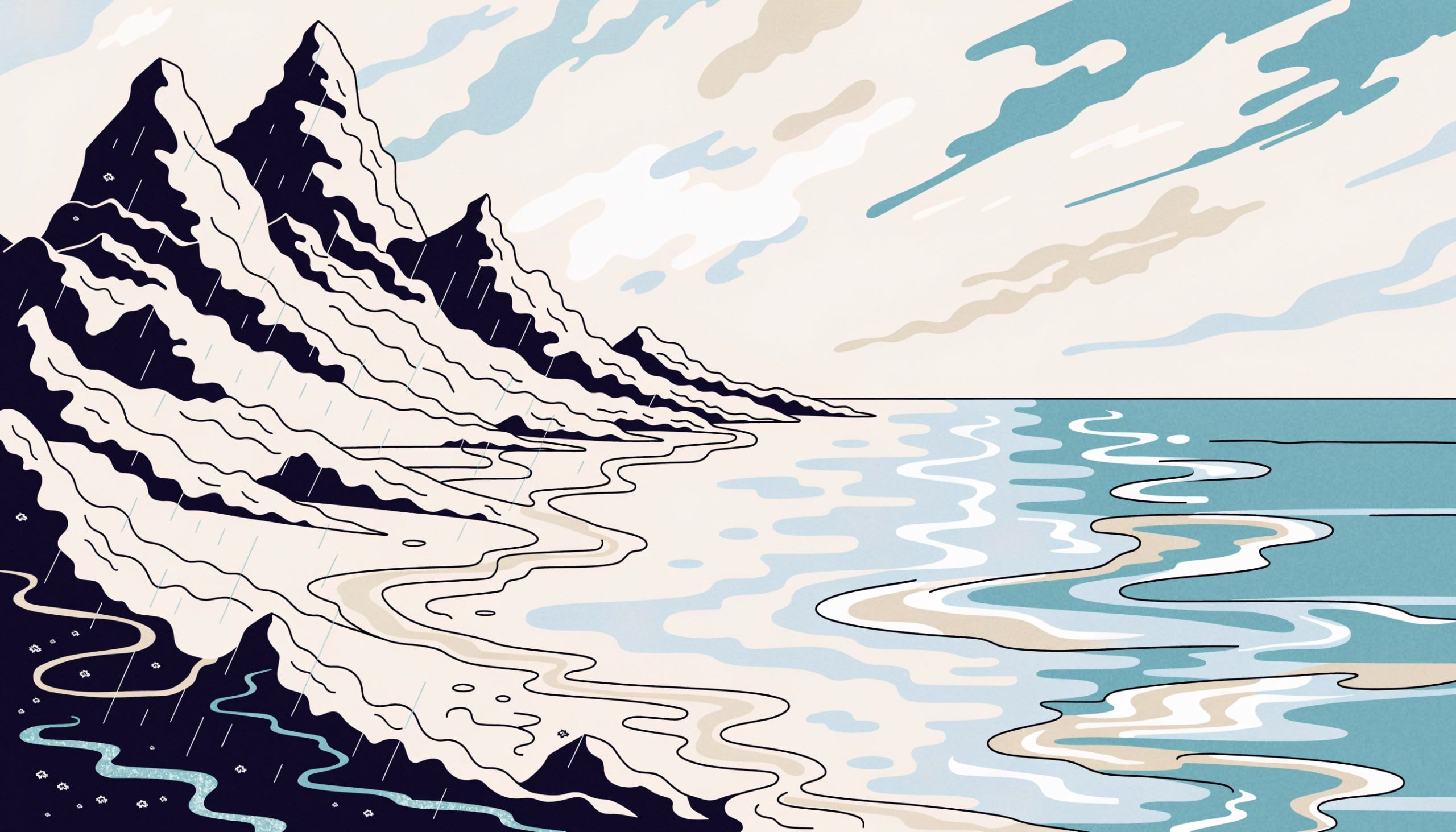
Rainwater isn’t pure. As it falls through the air it picks up a little carbon dioxide and turns faintly acidic. When it runs across rock, that quiet acidity pulls ions loose: sodium, calcium, chlorine, a small share of nearly everything that makes up the Earth’s crust. Rivers carry them out to sea, drop by drop.
In a single litre of fresh water the amount of salt is barely there, a few milligrams. But multiply that by the thousands of cubic kilometres of river that reach the ocean each year, and by the four billion years the Earth has spent running this machine, and the total turns enormous.
But rivers don’t explain everything. Chlorine, the most abundant ion in seawater, is precisely the one that’s rare in rock: erosion alone could never supply that much. Most of it comes from elsewhere, from volcanoes. Since the Earth’s earliest days, their eruptions and the hot springs tucked along the ocean floor have released chlorine, which dissolves into the water at once. The sea’s salt has two sources, then: the rock that rain wears slowly down, and the fire the planet breathes out.
The Sun concentrates, the water leaves
The other half of the answer is evaporation. The Sun lifts surface water off the ocean and sends it back up into the sky, where it falls again as rain. But when seawater evaporates, only the water leaves — the salt stays behind, dissolved in whatever didn’t go.
The ocean works, then, like a very slow saucepan. Rivers pour salt in, evaporation takes water out, and the salt builds up to a balance. Today the oceans hold about 35 grams of salt per litre: enough that a cubic metre of seawater carries close to 35 kilos of it.
Some seas saltier than others
Not every sea sits at the same concentration. The Mediterranean, an almost-closed basin under a hard sun, runs around 38 grams per litre. The Baltic, cold and barely evaporated but fed by a long list of rivers, drops below 10. The Dead Sea, with no outlet at all and the desert baking down on it, passes 340 grams per litre, ten times the open ocean, near the limit of what water can hold dissolved. You float on it without trying, and you don’t put your face in: the water stings.
Each sea, in its own way, tells a small story about what it takes in and what it lets go.
Resting on the floor of all that salt water are also some 1.5 million kilometres of cables, carrying your messages from one continent to the next. Why isn’t the internet in the sky?