The evidence that unsettles
Take a photo of the Moon when it’s grazing the rooftops. Wait three hours. Take another when it rides high overhead. Set the two shots side by side.
They’re identical. Down to the pixel.
That’s the first shock of this story: the Moon doesn’t change size between the horizon and the zenith. It doesn’t swell by a hair. The Earth-Moon distance shifts a little over a month, but not in one evening, and nowhere near enough for what your eyes are telling you. Your camera, for its part, never lies. It records the same small disc, roughly half a degree across, morning or night.
So if the sensor sees a constant disc and your brain sees a balloon down at ground level, the deception is manufactured somewhere between the eye and awareness. Welcome to one of the oldest puzzles in perception.
A trick three thousand years old
The effect has a name: the Moon illusion. And it’s ancient. Some trace its first mentions to cuneiform texts more than twenty-five centuries old. What’s certain is that Aristotle wrote about it in the fourth century BC. Ptolemy, in the second century, was still hunting for an explanation.
For a long time, people blamed the atmosphere. The thick layer of air near the ground would act as a magnifying glass, enlarging the image. Lovely idea. Wrong.
The atmosphere does do something, but the opposite: it squashes the Moon vertically, sometimes into a flattened egg. It reddens its light, just like a sunset. Enlarge it? No. Measure the disc with an instrument and the air doesn’t grow it by a fraction. No device records the illusion: it lives only in your perception. The culprit isn’t outside. It’s inside.
The ground that changes everything
Here is where it turns unsettling: nobody has a definitive answer. But one lead has held strong for decades.
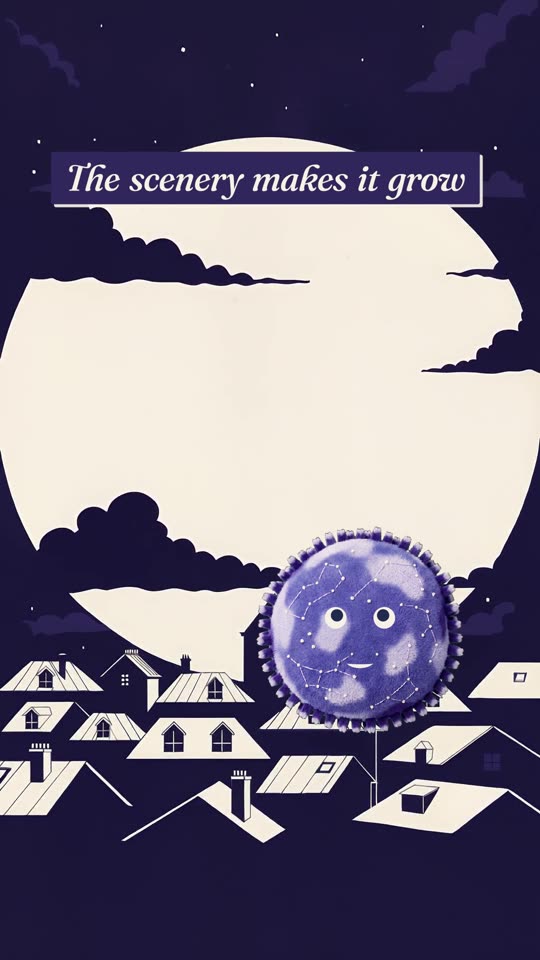
Your brain never judges a size in a vacuum. It compares. Always. When the Moon rises, it sits behind a line of trees, a steeple, a mountain ridge. The brain suddenly has distance cues: those objects, it knows, are far away. And a large object it believes to be distant, the visual system “corrects” into something more imposing still.
At the zenith, nothing. The Moon floats alone in the black, with no scale, no neighbor. The brain has nothing to measure it against. So it shrinks it.
There is another theory, almost the opposite, that speaks of the flattened sky dome. Look up: the sky doesn’t feel like a perfect half-sphere. It feels squashed, like a low lid. The horizon, meanwhile, seems to stretch far away. So your brain places the horizon Moon “farther” than the one overhead, and grants it a bigger size to compensate. The two explanations are still fighting it out in the journals.
One simple test rattles the magic. Next time a big Moon rises, bend down and look at it between your legs, upside down. The illusion deflates for the most part. The Moon suddenly looks far smaller. By breaking your usual cues, you jam the program that was inflating it.
What it says about your eyes
The most disorienting part is that knowing all this changes nothing. You could have read this article ten times. Tomorrow night, if the full Moon climbs behind a hill, it will look enormous to you. The illusion won’t be talked out of it by reason.
That is its real interest. It proves you don’t see the world as it is. Your brain doesn’t relay a raw image: it interprets it, corrects it, rebuilds it from cues, habits, guesses about distance. Most of the time those corrections save you, they let you catch a ball or judge a step on the stairs.
But now and then the program errs beautifully. A stone 380,000 kilometers away, motionless, that seems to breathe between the horizon and the sky.
It isn’t the Moon that grows. It’s you who builds it.