The word promises, the times disagree
On 23 September 2026 at 02
Paris time, the centre of the Sun crosses the celestial equator. That is the precise instant of the autumn equinox. The word comes from the Latin aequinoctium, built from aequus, equal, and nox, night. Attested in French around 1210, it carries its promise in its syllables: a night equal to the day.The ephemerides for that same 23 September give Paris a sunrise at 07
and a sunset at 19. Day length: 12 hours 9 minutes, nine minutes more than twelve. This overshoot repeats every year at the equinox, everywhere on Earth, always in the same direction. Its magnitude varies with latitude.Day is measured at the edge, not the centre

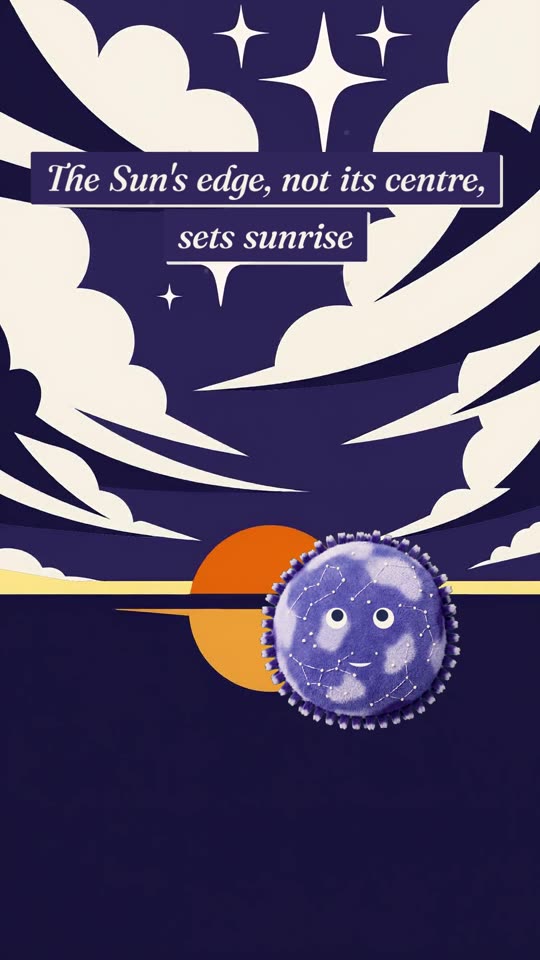
When ephemerides announce the time of sunrise, they mark the instant the Sun’s upper limb appears on the horizon. For sunset, it is the instant the last edge disappears. Not the centre: the edge.
The Sun is not a point. Its apparent diameter, as used in ephemeris calculations, measures roughly 32 arcminutes, a little over half a degree. Each morning, day begins while the disc’s centre is still below the horizon. Each evening, it ends while that same centre has already passed beneath. At both ends, you gain the equivalent of half a disc.
The atmosphere lifts the image
Air bends light near the horizon: it raises the disc’s apparent position by 34 arcminutes on average. The disc’s image therefore arrives before its geometric rise in the morning, and lingers after its geometric set in the evening.
Add them up: 34 arcminutes of refraction, plus 16 arcminutes of semi-diameter. At the conventional moments of sunrise and sunset, for a flat, unobstructed horizon and normal refraction, the disc’s centre sits 50 arcminutes below the horizon. A strange consequence: when the setting disc appears to rest fully on the horizon line, it has geometrically already sunk entirely below it. Refraction alone exceeds the disc’s diameter.
Equality exists, but not on that date
Day length is shrinking fast at this season: 3 to 4 minutes per day in Paris. The nine-minute surplus melts in two or three days. On 25 September 2026, the day in Paris still lasts 12 hours 1 minute; on the 26th, it drops to 11 hours 57 minutes. The crossover falls between the two.
This date of true equality depends on latitude. Around 40° north, it falls near 26 September. Closer to the equator, it drifts later: at about 5° of latitude, it comes closer to 15 October. At the equator itself, day length oscillates between 12 hours 7 minutes and 12 hours 8 minutes at equinoxes and solstices: twelve hours exactly is not reached there.
Equality has an address, not a date
The word equinox lies with elegance. It describes a world of pure geometry, without disc or air. That world does not exist.
The promised equality does arrive, a few days after the equinox. But it has no universal date: each latitude has its own, like an appointment set at different times depending on where you stand.