A bitten disc, still glowing
Night of 27 to 28 August 2026. An arc of shadow bites into the lunar disc, creeping forward like a clock hand. The logic seems airtight: Earth blocks the only light source, the disc should go dark.
It doesn’t. During a total eclipse, the Moon shifts to copper, sometimes brick red. Where does that glow come from if the obstacle is opaque?
Sorting the light
The Moon produces nothing. Everything we see on it is reflected sunlight. When Earth moves between Sun and Moon, our satellite enters a shadow cone roughly 9,000 km wide at that distance. Without an atmosphere, the disc would be nearly invisible during totality.
But Earth is wrapped in air. Sunlight grazes the planet’s edge and passes through that layer. Two effects combine. Air molecules scatter short wavelengths, blue and violet, far more than long ones: this is Rayleigh scattering, established in the 1870s. The blue isn’t destroyed; it goes in every direction. Far less scattered, red dominates what makes it through.
That red then undergoes refraction: its path bends crossing layers of air, and some enters the shadow. The atmosphere acts as a ring-shaped lens, injecting reddened light where direct sunlight no longer reaches. Same physics as a sunset.
What the colour reveals
The tint never repeats from one eclipse to the next. Astronomer André-Louis Danjon proposed a five-step scale in 1921 for total eclipses, from L0 (disc nearly invisible) to L4 (brilliant copper-orange). It now serves as an indicator of atmospheric transparency.
Volcanoes prove it. A major eruption injects sulfuric acid aerosols into the stratosphere; those droplets weaken the refracted light entering the shadow. After Pinatubo in June 1991, the eclipse of 9 December 1992 produced a dull grey disc, so dark it was hard to pick out. Same effect after Agung in 1963 and El Chichón in 1982.
Not the same eclipse
On 27–28 August 2026 the eclipse was partial: 93% of the lunar diameter entered the shadow at maximum, a crescent left in full sunlight. From North America, where maximum fell in the middle of the night with the Moon high, the copper tint had a real chance of showing. From Europe, maximum arrived during an already brightening dawn, the Moon very low in the west, and the shadowed portion looked mostly dark. What stays clearly visible in a partial eclipse is the shadow’s edge: a smooth arc steadily consuming the disc. That is what Aristotle observed around 350 BCE to argue Earth is round: only a sphere casts a circular shadow in every orientation.
A deep, unambiguous red belongs to total eclipses.
From the Moon
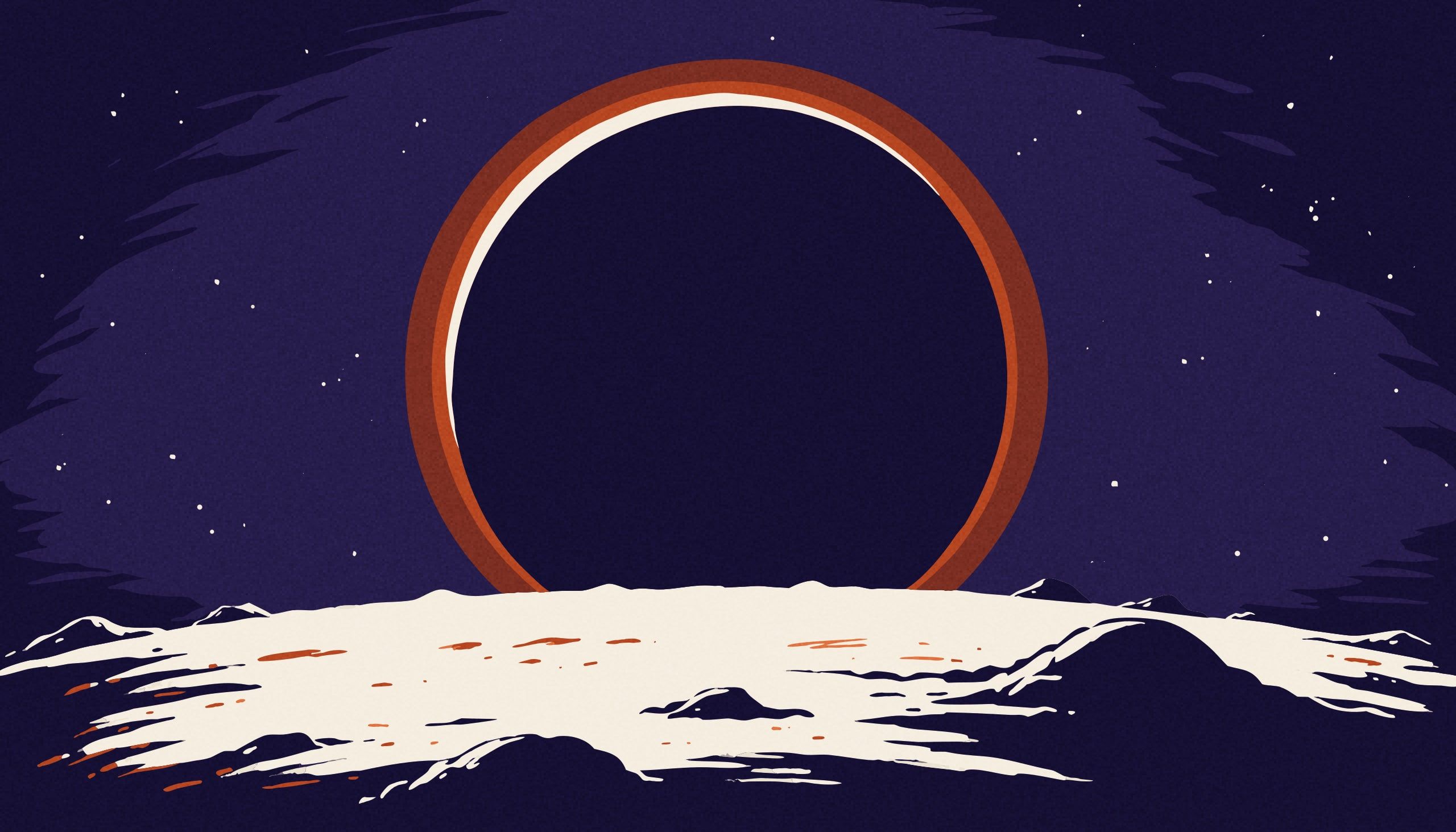
Reverse the viewpoint. Imagine standing on the lunar surface during totality. Earth fills the sky, a black disc ringed by a luminous red band. That band is every sunrise and sunset happening at that moment, all of them at once.
You are not watching an eclipse, but every sunset on Earth gathered into a single ring.