Seven moving lights
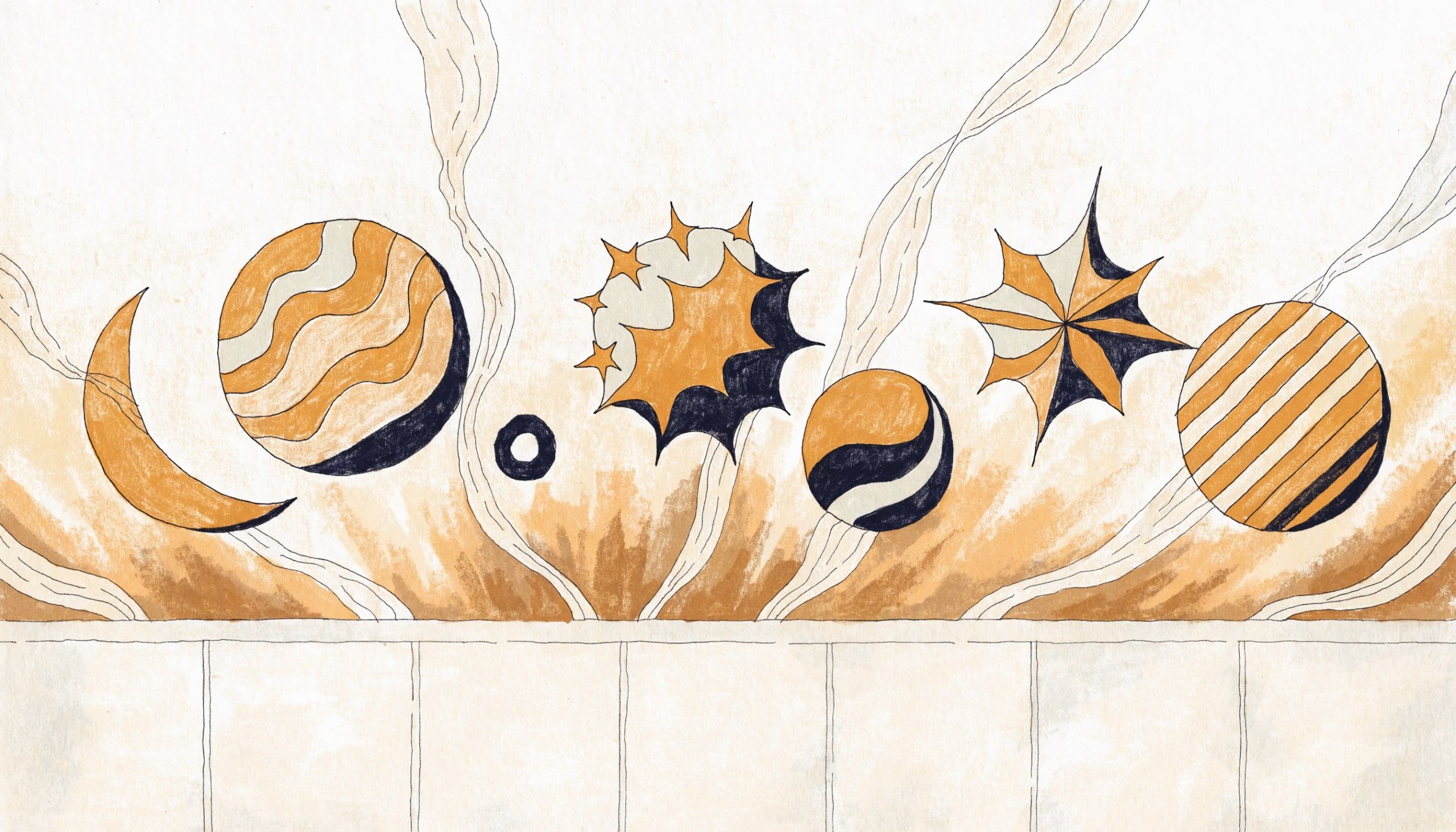
In ancient Mesopotamia, Babylonian astronomers watched the sky with the naked eye and noticed that seven celestial bodies refused to stay fixed like the stars. The Sun, the Moon, and five “wandering stars” we now call Mars, Mercury, Jupiter, Venus and Saturn. The Greek word planētēs (the source of planet) meant exactly that: wanderer.
These seven seemed to govern the visible sky. The Babylonians assigned each one an hour, then a day, and built a cycle of seven around them. The order we still use today carries that lineage: Monday (Luna, the Moon), Tuesday (Mars, kept in French mardi and Spanish martes), Wednesday (Mercury, mercredi), Thursday (Jupiter), Friday (Venus), Saturday (Saturn). Sunday alone, originally dies Solis (the day of the Sun, still legible in Sunday) was rebranded in Christian Latin as dies Dominicus, the Lord’s day.
A religious adoption, then an imperial decree
The Babylonian cycle spread along two channels. On one side, the Hebrew tradition picked it up early: the seven-day creation account, with the seventh set aside for rest (shabbat), anchored the seven-day week in Judaism, then in nascent Christianity and Islam.
On the other side, Rome. The Empire had originally run on an eight-day market cycle, the nundinae. But the seven-day rhythm arriving from the East (carried by astrologers and by religion) slowly took over everyday life. In 321 CE, Emperor Constantine made it official: an edict dated 7 March 321 imposed the seven-day week across the Empire and added a mandatory day of rest: Sunday.
From there, the seven-day week travelled wherever Europe travelled.
Others tried. None of it stuck.
There is nothing astronomically necessary about seven. No celestial period demands it. Which is why several regimes have tried to replace it.
Revolutionary France introduced the décade in 1793, a ten-day week designed to break with religious inheritance. It held for nine years, until Napoleon buried the experiment in 1802. The Soviet Union, between 1929 and 1931, tried a five-day week (the nepreryvka) and then a six-day one, hoping to keep factories running without a shared day off; it failed to keep families synchronised and was quietly rolled back to seven. Ancient Egypt counted in ten-day weeks, the decans. Imperial China ran on ten-day cycles too, the xún. None of those systems lasted.
Seven is neither a clean lunar cycle nor a clean quarter of one. But it is short enough to remember, long enough to breathe — and once enough people share a rhythm, no decree can pry it loose. The same lock holds the layout under your fingers, frozen since 1873 for a machine that no longer exists.
The rhythm itself hasn’t moved since Constantine. The way you feel it pass has. Why does time seem to speed up as we get older?