Too small to be round
Look at photographs of the Solar System’s smaller bodies. The asteroid Eros, captured by the NEAR Shoemaker probe in 2000, looks like a large grey peanut. Itokawa, visited by Hayabusa, has the silhouette of a battered potato. Phobos and Deimos, the two moons of Mars, each carry their own lumps. None of these objects are round. They are dented, crooked, riddled with hollows and points left by every collision they ever suffered.
The reason is simple: they are too small for their own gravity to have the last word. Their shape is whatever chance and impact handed them, frozen in place by the strength of the rock itself. There is no force inside them strong enough to smooth it out.
Gravity flattens whatever it can reach
Above a certain threshold (roughly 500 to 600 kilometres across for a rocky body, a little less for an icy one) a body’s gravity becomes strong enough to deform its own substance. It pulls every rock toward the centre with more force than the material can resist. Mountains that would stand too tall collapse. Basins that would sink too deep fill back in.
The equilibrium shape that emerges, the one that minimises energy, is always the same: a sphere. Every point on the surface ends up roughly the same distance from the centre. Astronomers call this regime hydrostatic equilibrium, and it draws the line between small, irregular bodies and the “large” ones: planets, dwarf planets, a handful of major moons. Pluto, Ceres, the Moon: all round. Eros, Itokawa: not round.
Spin gives them a bulge back
Even so, no planet is perfectly spherical. Rotation pulls equatorial matter outward and produces a slight equatorial bulge. On Earth, this bulge makes the radius at the equator about 21 kilometres larger than the radius at the poles: enough that Mount Chimborazo, in Ecuador, is in fact the point on the surface farthest from the centre of the Earth, ahead of Everest.
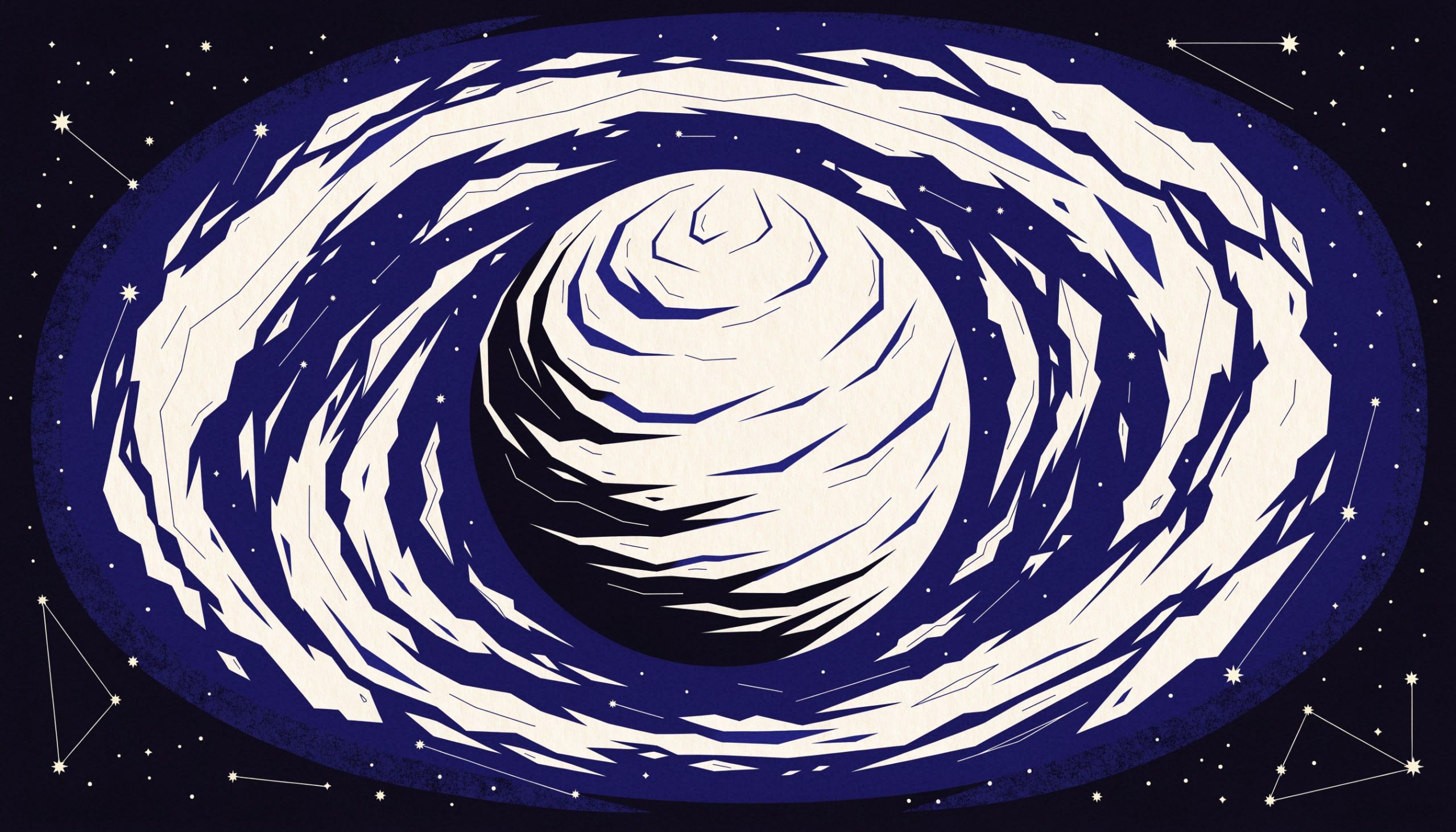
The faster a planet spins, the more it flattens. Jupiter, which finishes a day in under ten hours, has an oblateness you can see in a backyard telescope. Saturn, more fluid still, is the most flattened planet in the Solar System: nearly 10% difference between its equatorial and polar radii.
A round planet, then, is a massive body that has let itself be crushed by its own gravity — and that keeps, at the equator, the memory of its spin.
You can spot them in the evening without a telescope: among the points of light, they’re the ones whose glow doesn’t tremble. Why do stars twinkle?