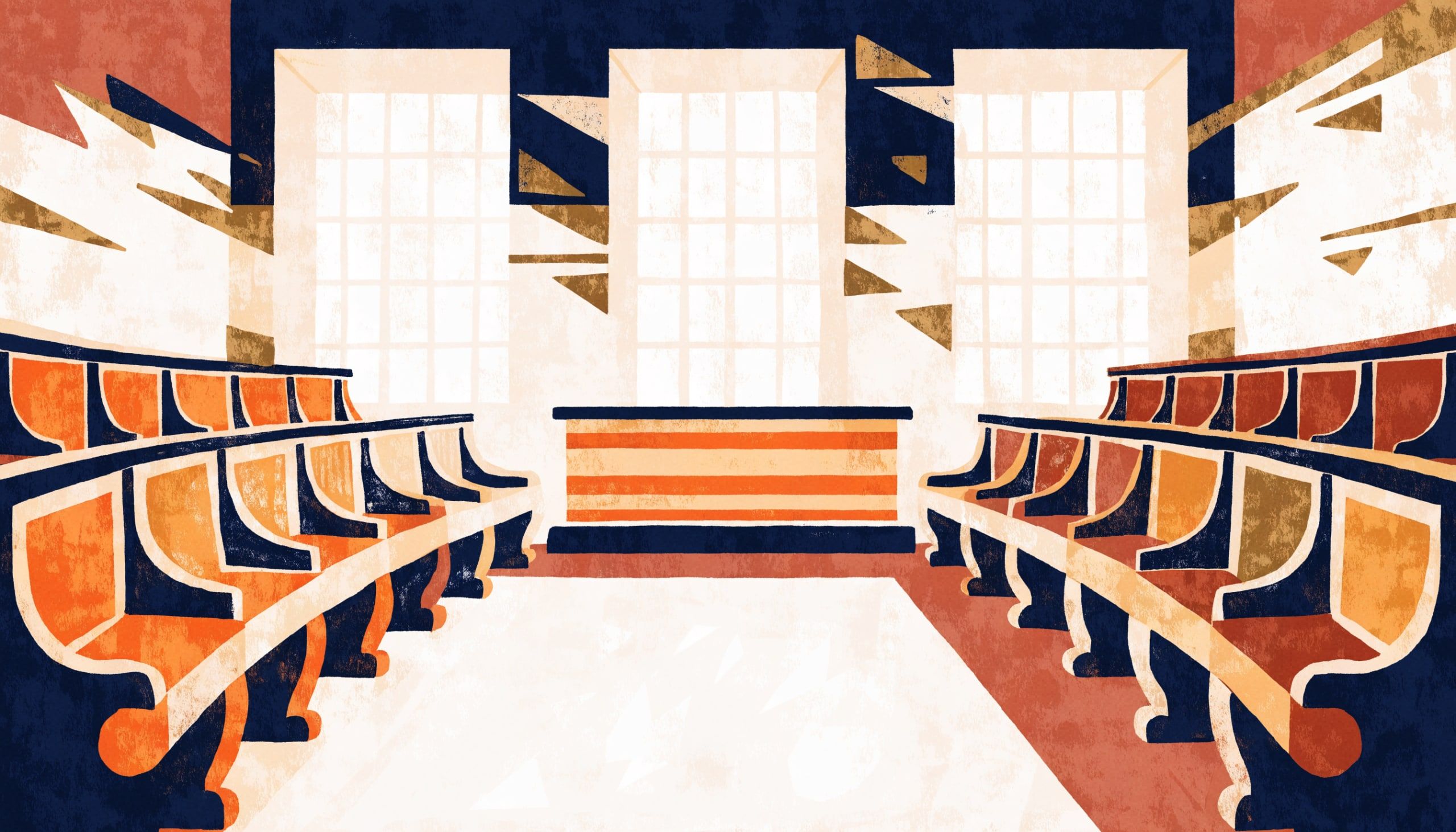
An assembly that picks a side
In the autumn of 1789, revolutionary France had just abolished privilege and now had to rebuild its political order. The National Constituent Assembly was deep in a burning question: would the king hold a right of veto over the laws passed by the deputies? Absolute, suspensive, or none at all?
The debates ran hot, the factions tore at each other. To keep speakers who would otherwise insult one another from sitting in the same row, a simple practice took hold. Those who wanted to preserve the king’s authority (the ones in favour of a veto) fell into the habit of sitting to the right of the presiding officer, a place treated since antiquity as the seat of honour. Their opponents, the radicals and reformers, settled on the left. In the middle, a floating mass that would later be called the Marais or Plaine under the Convention of 1792.
The choice was, at first, purely practical: you grouped yourself with the people who thought like you. But it lasted.
From the room to the word
The deputies kept their seats. From one session to the next, from one regime to the next, the political geography hardened. Under the Restoration (the 1820s), the expressions settled into parliamentary language for good: côté droit for the ultras and conservatives, côté gauche for the liberals. Their spread through the press as labels of political identity came later. It would take the end of the nineteenth century and the start of the twentieth for the right and the left to become everyday categories beyond the chamber itself.
The vocabulary travelled. As other European countries adopted parliamentary assemblies through the nineteenth century, the terms followed: Left / Right in English, Links / Rechts in German, Sinistra / Destra in Italian. The same metaphor everywhere, the same inheritance from a Parisian room in 1789.
And if it had been the other way around?
There is nothing necessary about this arrangement. If the chair of the 1789 Assembly had faced the other way, if the monarchists had ended up to his left by accident or convenience, we would today be talking about a “swing to the left” to mean a conservative turn. Political content has no link with handedness. Only the habit of one particular room petrified the metaphor.
And yet the word survived almost everything: the end of the monarchy that had seen it born, the Republic, the Empire, the Restoration, several Republics after that. It survived chambers that no longer respect the original geography, semicircular parliaments where the metaphor is nearly drained of meaning, political systems with no physical chamber at all.
We still speak, in 2026, of left and right — because in the autumn of 1789, in a room at Versailles, someone had to choose where to sit.
Other choices made once, long ago, still govern us without our questioning them, right down to how we carve up our days. Why does the week have seven days? Or how we lay out the keys under our fingers. Why isn’t the keyboard in alphabetical order?