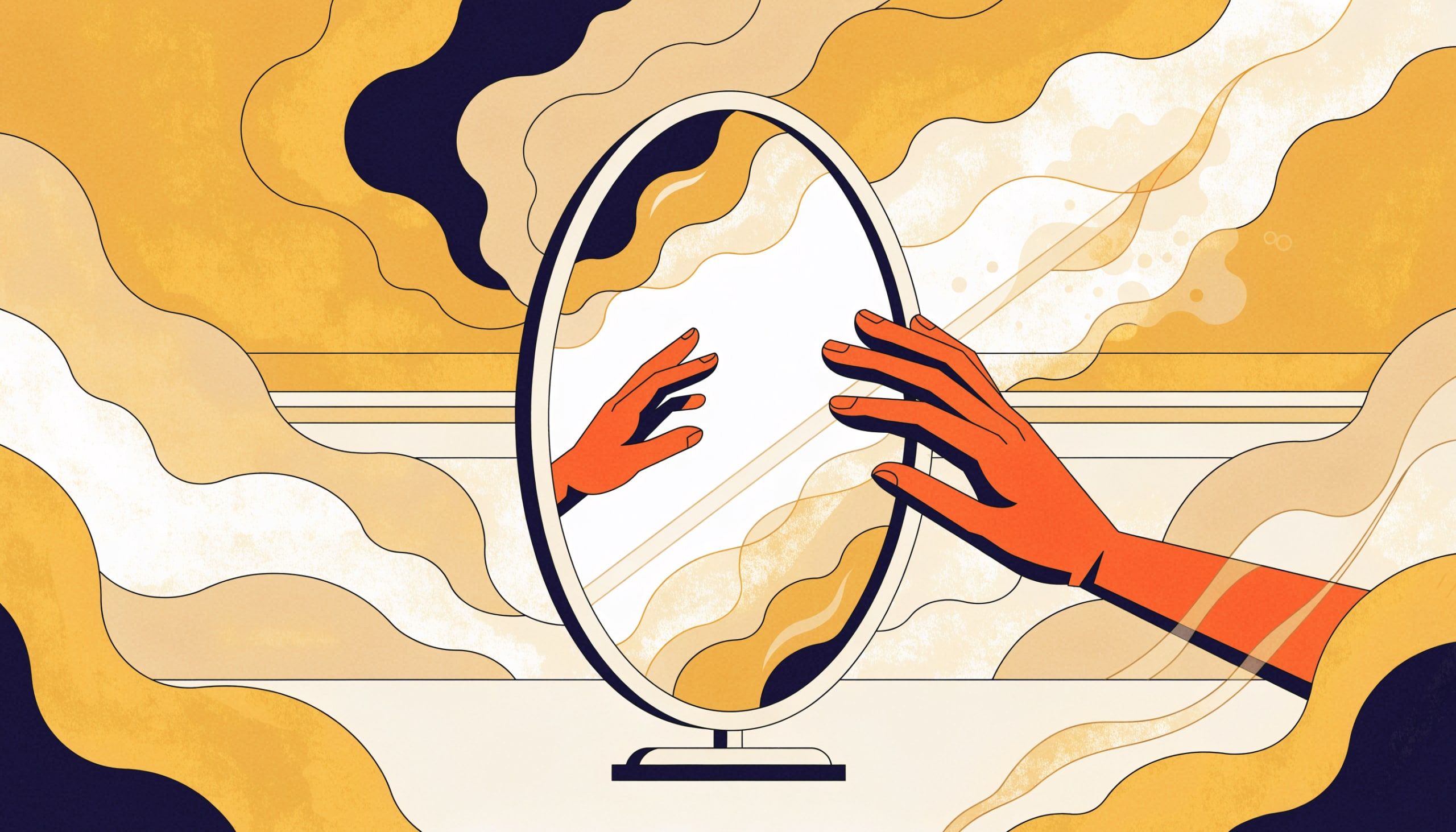
The mirror does only one thing
Take a letter written on a transparent sheet. Press it against the mirror: the reflection shows you exactly the same letter, in exactly the same spot: no higher, no lower, no further left, no further right. The only thing the mirror has changed is what was heading toward it. Depth (the front-to-back axis) has been flipped. Nothing else.
If you saw a photograph taken through a mirror, with simply the front and the back swapped, you probably wouldn’t know it was a reflection. The mirror doesn’t know what you call “left” or “right”. It doesn’t even know there’s anyone in front of it. It returns light by flipping a single axis: the one running from you to it.
So why do we see a reversal?
Because our brain refuses to read the reflection for what it is. It tries to interpret it as a person facing us. And a person facing us has turned: they’ve pivoted 180° to look our way. If they had a left hand, that hand now lands on our right side. That pivot is something we project onto the mirror’s image, not something the mirror has done.
Your reflection itself didn’t pivot. Its left hand is still on the left. But because your brain compares it to an imagined person who has turned to face you, it labels that hand “right” — and cries reversal.
The mirror is silent. We’re the ones speaking on its behalf.
Lie down, and the mirror changes its mind
Here’s the experiment that settles it: lie on your side in front of a mirror. Your feet point left, your head points right. Look at your reflection. It has, you’d say, its head at the bottom. And its feet at the top.
The mirror itself has done nothing different. It still flips the same single axis (front-to-back). But this time your brain, trying to picture the imagined person facing you, has to imagine them rotated through a horizontal pivot rather than a vertical one. So the apparent reversal switches axes: it becomes top-and-bottom instead of left-and-right.
The physicist Richard Feynman put it this way in a 1983 interview: “front and back have been reversed”: a mirror flips depth, and everything else is a property of the person looking. Physics is simple. We are the complicated part.
Your reflection isn’t the only version of you your brain quietly rearranges. Why does your own voice sound strange when you hear it recorded?