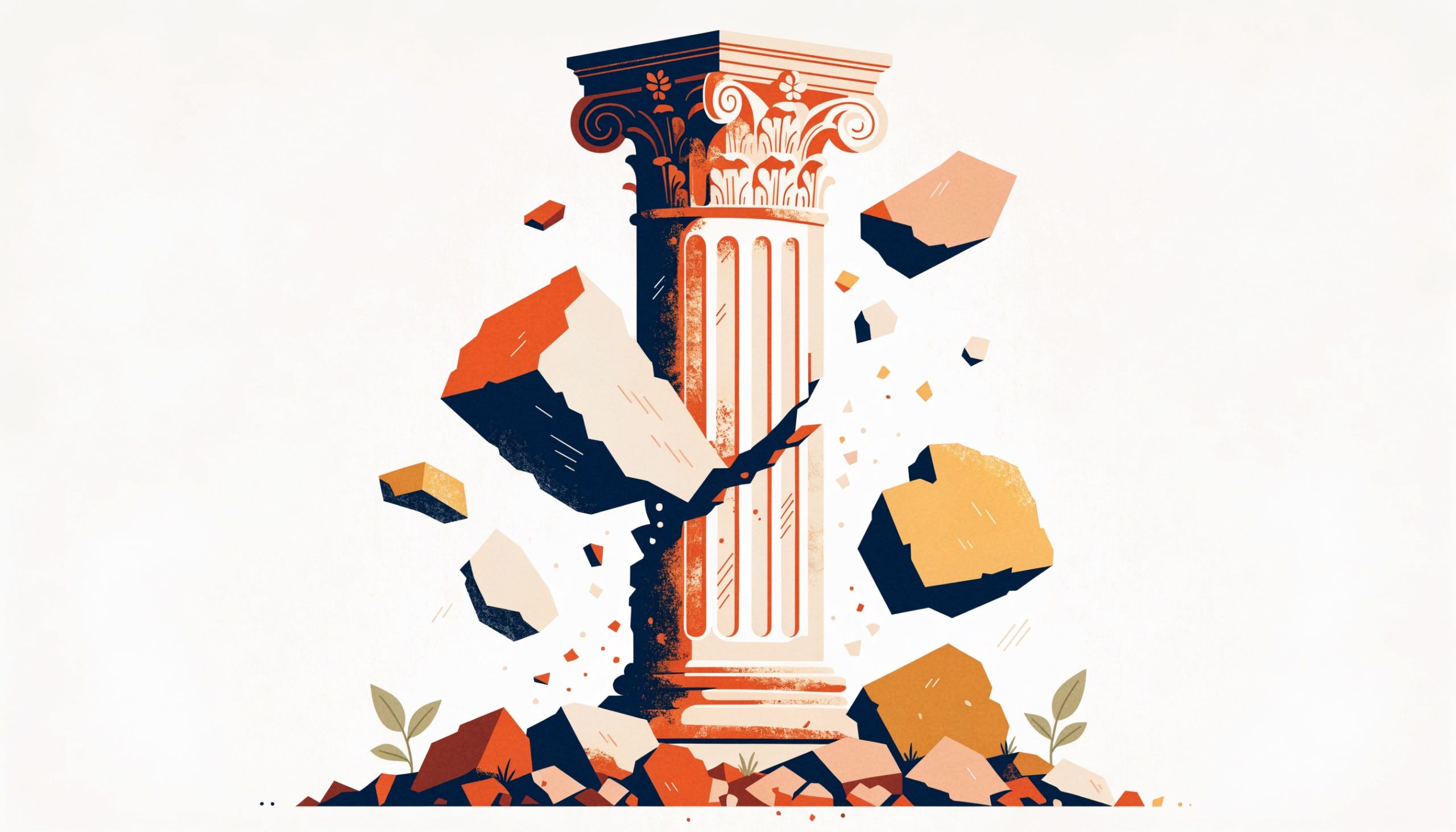
They rarely fall in a single day
We talk about the fall of Rome as if it were an event, one morning, in 476. In reality, Rome declines over five centuries. Its institutions thin out, its borders fray, its tax revenue dries up. The official ending (the deposition of the last Western emperor by the Germanic chieftain Odoacer) is just the final breath of a body that had been dying for a very long time.
The Maya? They don’t abandon their cities on a single day either; they empty them over roughly 150 years, between 750 and 900. The USSR? Some two decades of stagnation (1964-1985) before the rupture of 1991. The Late Bronze Age East? A synchronous wave of collapse around 1200 BCE, in which the great civilizations (Hittites, Mycenaeans, Levantine kingdoms) fall one after another within a century.
A collapse is almost always a trajectory, not a blow.
The complexity spiral
In 1988, the anthropologist Joseph Tainter offered a structural explanation that fits remarkably well across very different contexts: the diminishing returns of complexity.
To keep functioning, an empire has to keep adding administrative, military and logistical layers. Collecting taxes over a wider territory costs more. Defending a longer border takes more troops. Governing a more diverse population calls for more bureaucrats.
Early on, each new layer brings in more than it costs. Past a certain point, the equation flips: every additional level of complexity costs more than it returns. The empire becomes a colossus that burns all of its energy just keeping its own machinery turning. When a shock arrives (war, plague, drought), there are no reserves left to absorb it. The fall isn’t caused by the shock; it is triggered by it.
The cycles repeat
The mathematician and historian Peter Turchin developed a quantitative approach, cliodynamics, which models political cycles running over two to three centuries. His recurring diagnosis: elite overproduction.
When a society prospers, positions of power become enviable, and the ruling classes have more children. There comes a moment when ten qualified candidates compete for every seat at the top. The losers do not stay quiet. They become frustrated counter-elites, ready to back movements of rupture. Inequality climbs in parallel, wealth concentrates, and the institutions that worked through the boom stop answering the country’s needs.
Legitimacy erodes. Reforms stall. Institutions calcify. A very rich minority sits next to an unhappy majority and to rival elites at each other’s throats. From there, an external shock is enough to take everything down.
The same pattern shows up in the crises of fourteenth-century Europe, in the seventeenth-century revolutions, in the end of Qing China, in the American Civil War. It does not predict when a collapse will happen (shocks are unpredictable) but it does describe rather well under what conditions a society becomes fragile.
These tools have their limits, but they at least carry this virtue: they remind us that no empire ever thought it was in decline a few decades before it collapsed.
Not every human settlement collapses with a roar. Some fade almost without a trace, and the world forgets them. Why did the Vikings reach America nearly 500 years before Christopher Columbus?