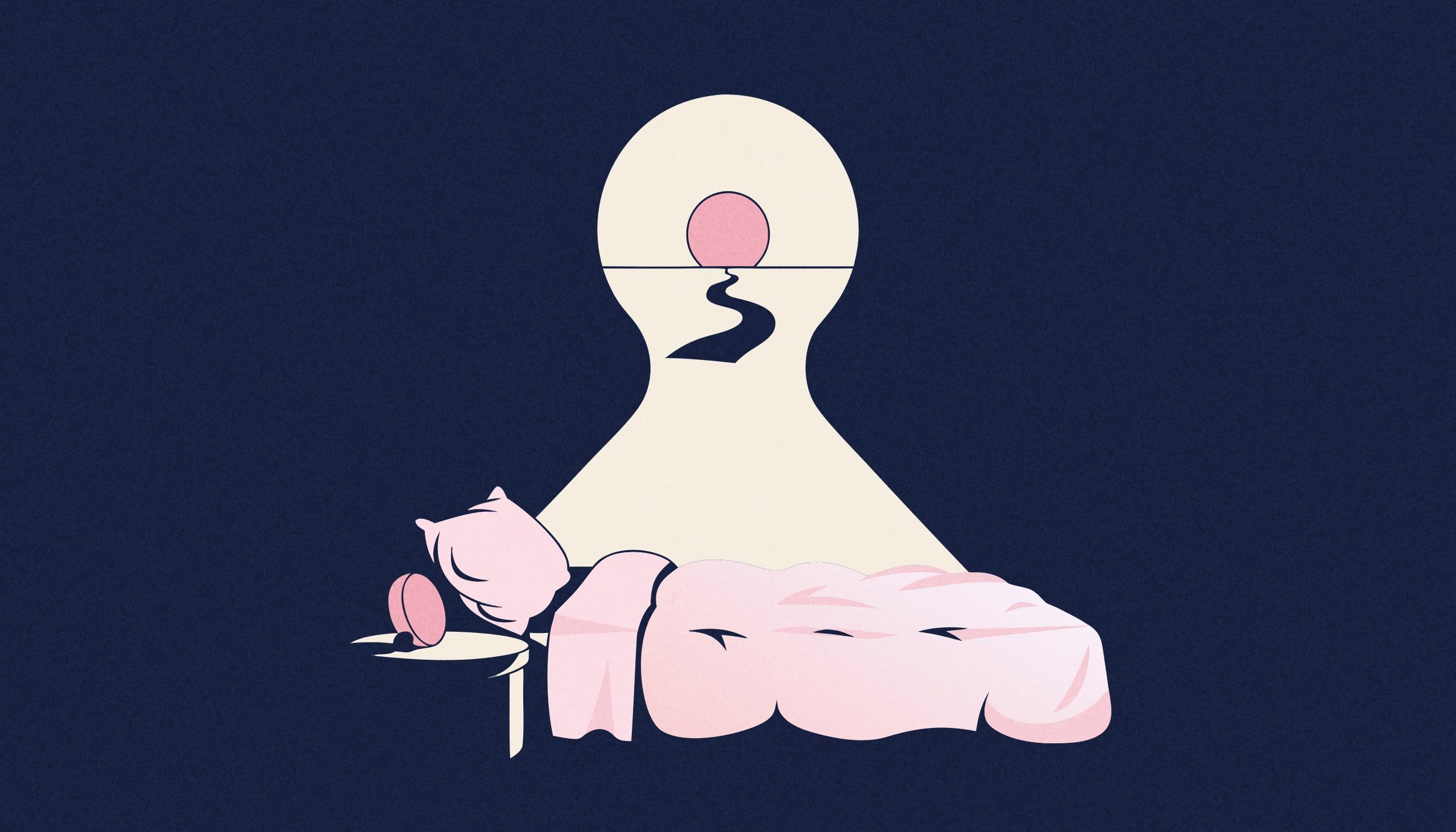
The ceiling becomes a screen
You get into bed earlier than usual. Tomorrow you need to be sharp. The pillow is cool, the room is quiet, and yet the ceiling turns into a screen playing tomorrow on loop.
First day back at school, an exam, a job interview, a race: your body is in bed, your mind is already there.
Nothing pathological. A study of 283 elite Australian athletes found that 64% of them experienced degraded sleep at least once before a major competition over a twelve-month period. The sticking point: falling asleep, in 82.1% of cases. The cause: thoughts directed at the event, in 83.5% of cases. The rest of the time, their sleep was stable. The night before, something gets in the way.
Preparing means keeping watch
When your thoughts turn toward tomorrow, they activate the alert system: a state of vigilance that keeps the body awake, making no distinction between what matters and what threatens. To that system, they are the same thing. It keeps the light on.
The mattress becomes a stage where you rehearse your day. You anticipate, you adjust. But every thought tells your body the same thing: stay awake, there is something to watch for.
The trap closes. Monitoring your own sleep is still watching.
The effort that delays
Researchers have measured this: participants placed under a cognitive load (military marches playing in the background) and told to fall asleep as fast as possible took longer than those told to simply let go. The command to sleep recruits an inner sentry that constantly checks whether sleep has arrived. That sentry, by definition, keeps you awake.
The clock makes everything worse. One experiment showed that watching the time while trying to fall asleep lengthens the delay, whether you are a good sleeper or a bad one. The math of “six hours left… five and a half…” feeds the loop. It is not the monitoring itself that hurts. It is the hour.
Five minutes to offload
At Baylor University, 57 young adults were hooked up to electrodes for a night of polysomnography, then asked to write for five minutes before lights out. One group listed tomorrow’s tasks. The other listed what they had already done. The first group fell asleep in 16 minutes. The second, in 25. Nine minutes gained. The more specific the list, the faster they fell asleep.
That is the authors’ interpretation: writing the list down frees working memory. What loops is not the event itself but the unwritten list. Once it is on the page, it stops demanding your attention.
Turn the alarm clock to face the wall. Leave the phone out of reach. The less you calculate, the less the loop feeds itself.
The night doesn’t wait
The night works without asking permission. Even restless, even threaded with thought, it carries on in silence. You will wake up feeling like you barely closed your eyes, and yet you will have slept more than you believe.
The big day doesn’t wait for a perfect night. It waits for you to get up.