Cloudy water, not paint
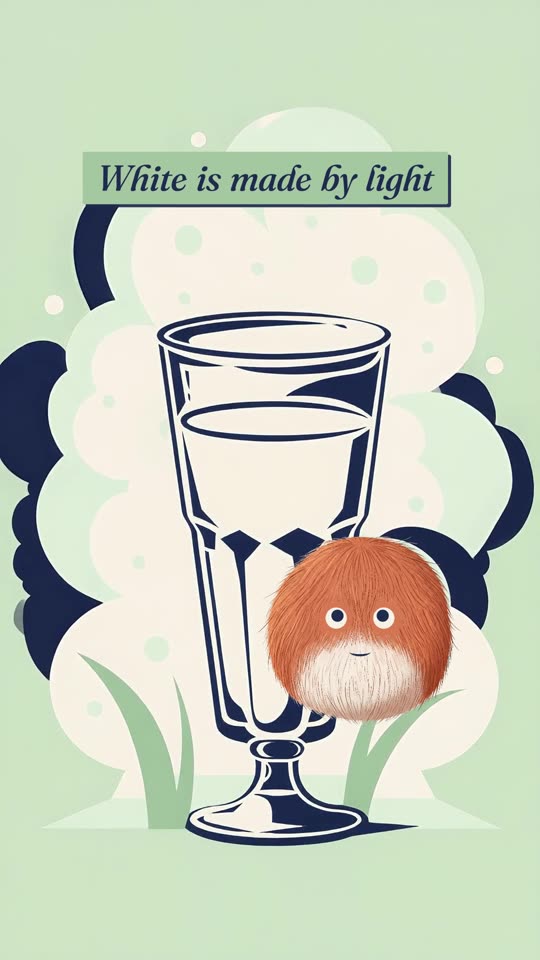
Pour a glass of milk. It looks smooth, even, almost solid. Wrong.
Beneath the surface hides a crowd. Billions of fat droplets float there, each one smaller than a speck of dust. Alongside them drift clumps of protein, tiny as well. The whole thing sits in water, because milk, at around 87 percent, is water. Water swarming with particles far too small to see.
This mixture has a name: an emulsion. The fat doesn’t dissolve in the water, it scatters through it as beads. Like a vinaigrette shaken very, very hard.
Light bounces and gets lost
The color, here, comes from no pigment. It comes from a game between light and those beads.
When daylight strikes the milk, it meets the fat droplets and the protein grains. At every encounter, it ricochets. It sets off in one direction, then another, then another, millions of times before it finds its way out. This is called scattering.
And here is the secret: these particles send back every color of light in the same way. Red, blue, green, none is favored. When an object returns the whole spectrum equally, our brain reads it as white. Snow does the same. So does the foam on a wave.
Skim it, and the white fades
Take out the fat, and watch what happens.
Skim milk keeps its proteins but loses its fatty beads. As a result, it scatters less light. It turns more translucent, faintly blue at the edges, almost grey at the bottom of the glass. That bluish cast is no accident: the fine particles that remain send back a little more blue than the other colors. Casein, milk’s main protein, keeps returning the light, but on its own it doesn’t manage nearly as well.
Cream does the opposite, brimming with fat droplets. Denser in beads, it is more opaque, a thick white.
Butter pushes the logic to its limit. Nearly all the fat is packed into it, and its color turns pale yellow. That yellow comes from carotene, an orange pigment the cow takes in with the green grass. The fat traps it, the water of the milk dilutes and hides it. A cow fed on winter hay gives a paler butter than a cow out on spring pasture.
And the green of the grass?
Chlorophyll, the pigment that colors grass green, doesn’t survive digestion. In the stomach it loses its magnesium atom, breaks down into brownish compounds, and leaves almost entirely in the dung. Less than 5 percent reaches the blood. Carotene, though, that orange pigment hiding under the green of the same grass, holds up better. Fat-soluble, it travels all the way to the milk and tints the butter yellow. The green stays in the field. Only a hint of orange makes the trip.
White for the calf, not just for us
Sheep’s milk looks even whiter and creamier than a cow’s. Buffalo milk, the kind used for mozzarella, is dazzling. It isn’t only a matter of fat: sheep and buffalo turn nearly all the carotene from the grass into colorless vitamin A. Their fat carries no yellow pigment, where a cow’s keeps a trace of it.
None of this is an aesthetic accident. The whiteness simply signals one thing: the milk is full. Full of fat for energy, full of casein for growth. A calf, a lamb, a kitten sees no pretty color in it. They find something to grow on, fast.
Next time you pour a glass, remember. That frank white isn’t a shade. It’s light that lost its way.
The sky, for its part, does the reverse with the same light: it keeps only a single color. Why is the sky blue?