Everything around you jumps
A cat leaps off the sofa. A goat bounds up a rock face. A child clears a puddle with both feet off the ground. Jumping is so ordinary that it disappears from notice: bend the legs, push harder than your own weight, leave the ground, land.
The elephant does not do this. No published measurement has ever recorded an elephant with all four feet off the ground at the same time. This is not a behavioural quirk. It is a structural impossibility.
When size grows, mass pulls ahead
An adult African savanna elephant weighs roughly 2,800 kg for a female, around 6,000 kg for a male. That figure alone does not explain the prohibition. The real key is a rule of geometry.
A muscle’s power follows its cross-section, which is an area. Mass follows volume. Double the size of a body: its force multiplies by four, its weight by eight. The larger the animal, the less power remains per kilogram to lift.
Legs built to bear, not to launch
Large mammals hold their limbs straighter beneath the body than small ones do. A limb aligned with the push from the ground spares the muscles more: this is how a massive animal can support its weight without disproportionate musculature. The elephant moves with more vertical limbs than most other animals, though they are not locked rigid: in walking, they bend and absorb.
But a jump demands the exact opposite. You must crouch low, then release in a sharp burst. And you need springs: explosive calves. The elephant’s lower leg is not devoid of muscle: dissection describes several thin ones and a thick one, organised for bearing heavy weight. What is missing is not force. It is the spring.
The foot that absorbs, not the one that launches
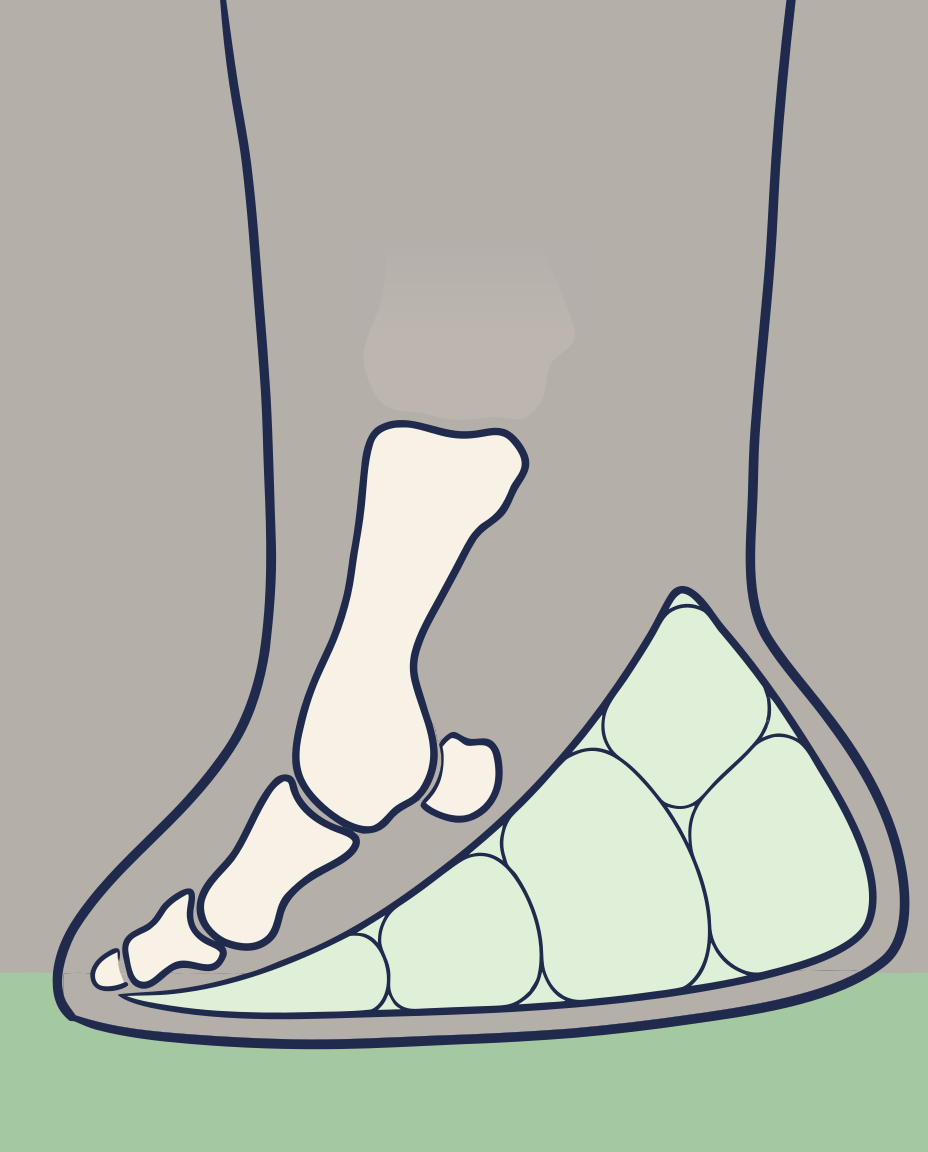
Beneath its round foot, the elephant actually rests its weight on the tips of its toes, as if standing on tiptoe. Behind them, a thick pad of fat compartmentalised by fibres fills the back of the foot. Its role, established by dissection: distribute the pressure of each step and cushion the impact. An architecture shaped to set down tonnes gently, not to propel them.
Jumping also means landing. A body of several tonnes returning to the ground must absorb a shock greater than its own mass, limbs bent, in an instant. No study has measured such a landing. But the logical consequence is clear: what the body gains in load-bearing capacity, it loses in capacity to absorb a vertical impact.
Even at full speed, the ground does not let go
In Thailand, researchers timed 42 Asian elephants on a track roughly thirty metres long. The reliable record: 6.8 m/s, or about 25 km/h. Far from slow.
The same team then analysed more than 2,400 strides across 62 elephants of both species, from the lightest (116 kg) to the heaviest (4,632 kg). At least one foot always remains on the ground. Never all four off the ground simultaneously. No trot, no gallop, at no gait.
On 34 Asian elephants measured on force platforms, up to 5.0 m/s, the centre of mass rises and falls like a ball bouncing at speed: the mechanics of running are there, in the rhythm. But the ground does not let go. Even its run is a form of walking.