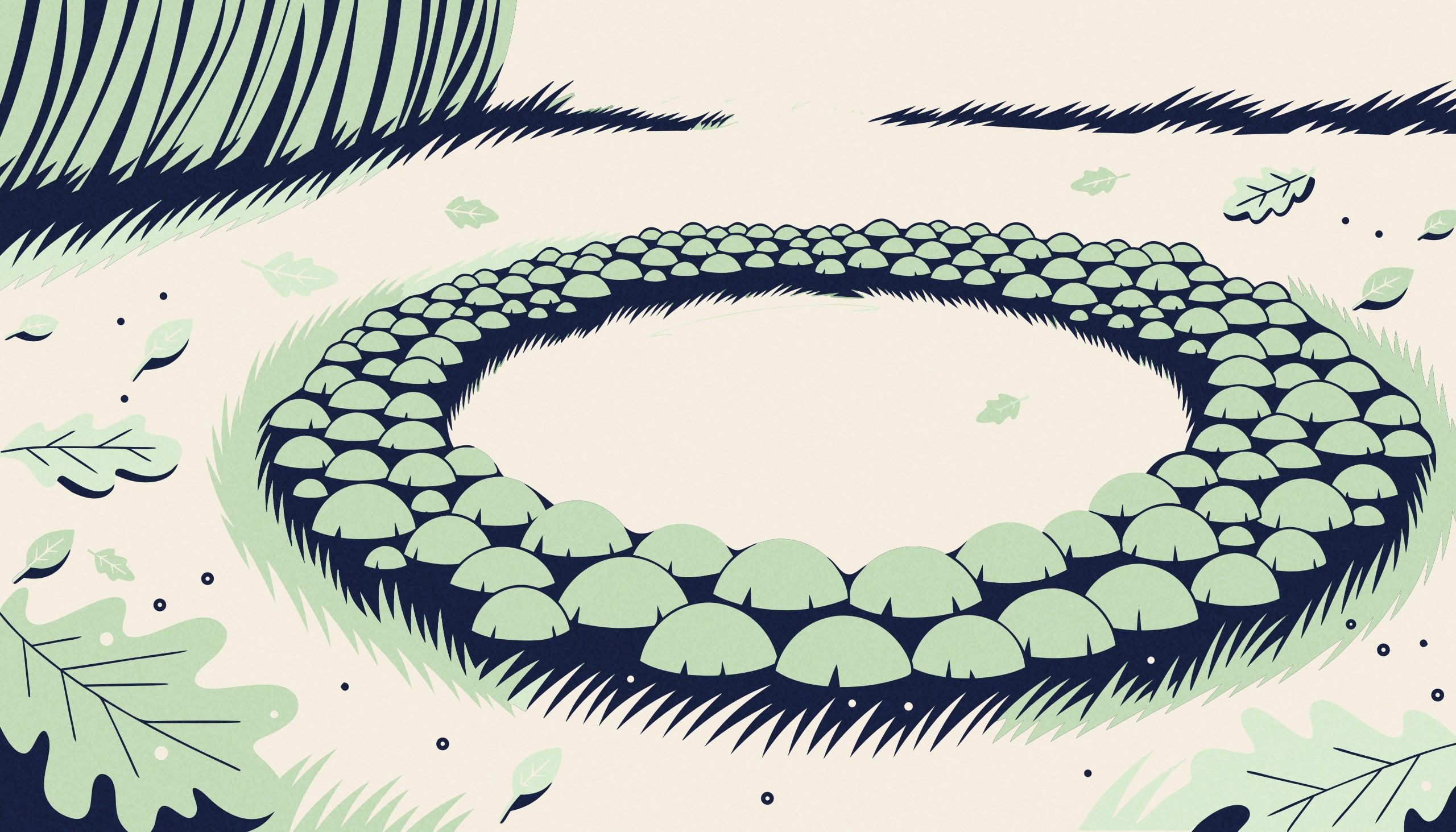
The ring is an edge
You are walking across a lawn that has stayed damp, and there they are: brown caps arranged in an arc. Not scattered: aligned along a clean curve.
These caps are not a collection of separate individuals. In the usual case, they belong to the same organism, a network of underground filaments called mycelium. What you are seeing is its edge. The network spreads from its periphery, and the caps, reproductive structures tasked with releasing spores, appear where the front advances.
A widening ring
It all begins with a germinating spore, or a fragment of mycelium. The network spreads in every direction at much the same speed, as long as the soil is uniform. At the edge, young filaments secrete enzymes, break down organic matter, and draw their nourishment from it. The front pushes into fresh ground.
Behind it, the older mycelium dies back. The new filaments do not return to soil already crossed; they stay at the periphery. The active zone thus takes the shape of a ring.
Why this refusal to return? Two hypotheses have competed for two centuries: either the resources in the inner soil are exhausted, or substances left behind by the dead mycelium prevent the same species from regrowing. The question remains open.
A complete circle requires uniform, unobstructed soil. A compacted path, a change in terrain, is enough to break it into arcs. On slopes, researchers believe the ring deforms into an open arc. In two recent counts, arcs outnumbered complete rings. Under trees, where the ground vegetation is too sparse to betray the fungus’s passage, the ring announces itself only through its caps; some forest species live in association with roots and depend on trees.
A speed, an age
The front advances at roughly 10 to 60 centimetres per year, depending on the species. The genus Marasmius, which includes the fairy ring champignon, progresses at 7 to 39 centimetres per year according to published measurements.
Age is calculated by dividing the radius by the speed. A circle two metres in diameter, advancing at 30 centimetres per year, would be roughly three years old. In the prairies of Colorado, the authors of a 1917 study estimated the average speed of a local species at 12 centimetres per year and deduced that a ring 60 metres in diameter would be around 250 years old.
The grass gives it away
By breaking down organic matter, the mycelium releases nitrogen that the grass absorbs like fertiliser: a darker, taller band traces the front. Elsewhere, the mat of filaments makes the soil hydrophobic. Water penetrates poorly, fine roots go short of water, and the grass yellows. Some rings show no effect on the vegetation at all.
The two bands can coexist within a single ring. Water shortage weighs most heavily in dry weather. In the fairy ring champignon, measurements around two rings have found cyanide levels sufficient to inhibit root growth. Recent mathematical models suggest that, for fairy rings in general, water shortage would be the primary factor and toxicity a secondary one.
The mycelium is present all year round; the caps appear only when the soil has stayed damp. For the fairy ring champignon, the typical species of lawns, this falls in late summer and autumn.
When two rings meet
Wollaston, who tracked the growth of fairy rings in English pastures in the late eighteenth century, observed more than twenty cases of rings coming into contact. In his observations, the sections between the points of contact fade on both sides, and the rest of each ring continues. Models predict other possible outcomes.
The ring is neither a design nor an intention. It marks the progress of a front into soil not yet occupied, by itself or by a neighbour.