A well-documented contradiction
Every late October, Halloween puts the same ritual back on display: queues outside haunted houses, packed cinemas for horror films, children in costume out to startle the neighbours. For the rest of the year, fear has one precise job: to keep you away from danger. It tightens the chest, speeds up the heart, makes you want to run. Nobody finds it pleasant.
And yet. A survey of 1,070 North American adults found that 54.5% of them say they enjoy horror content. Among all respondents, nearly 79% prefer it to be at least moderately frightening. Not a mild shiver: a proper scare.
Researchers at Aarhus University in Denmark have given this behaviour a name: recreational fear. It describes any situation where fear and pleasure are felt together, not a watered-down fear or an absence of fear. Horror films, haunted houses, rollercoasters, children’s games like hide-and-seek or being chased: all of it falls within this scope.
The contradiction fits in a single sentence: a system designed to make you avoid danger, which you deliberately seek out for pleasure.
The body sounds a real alarm
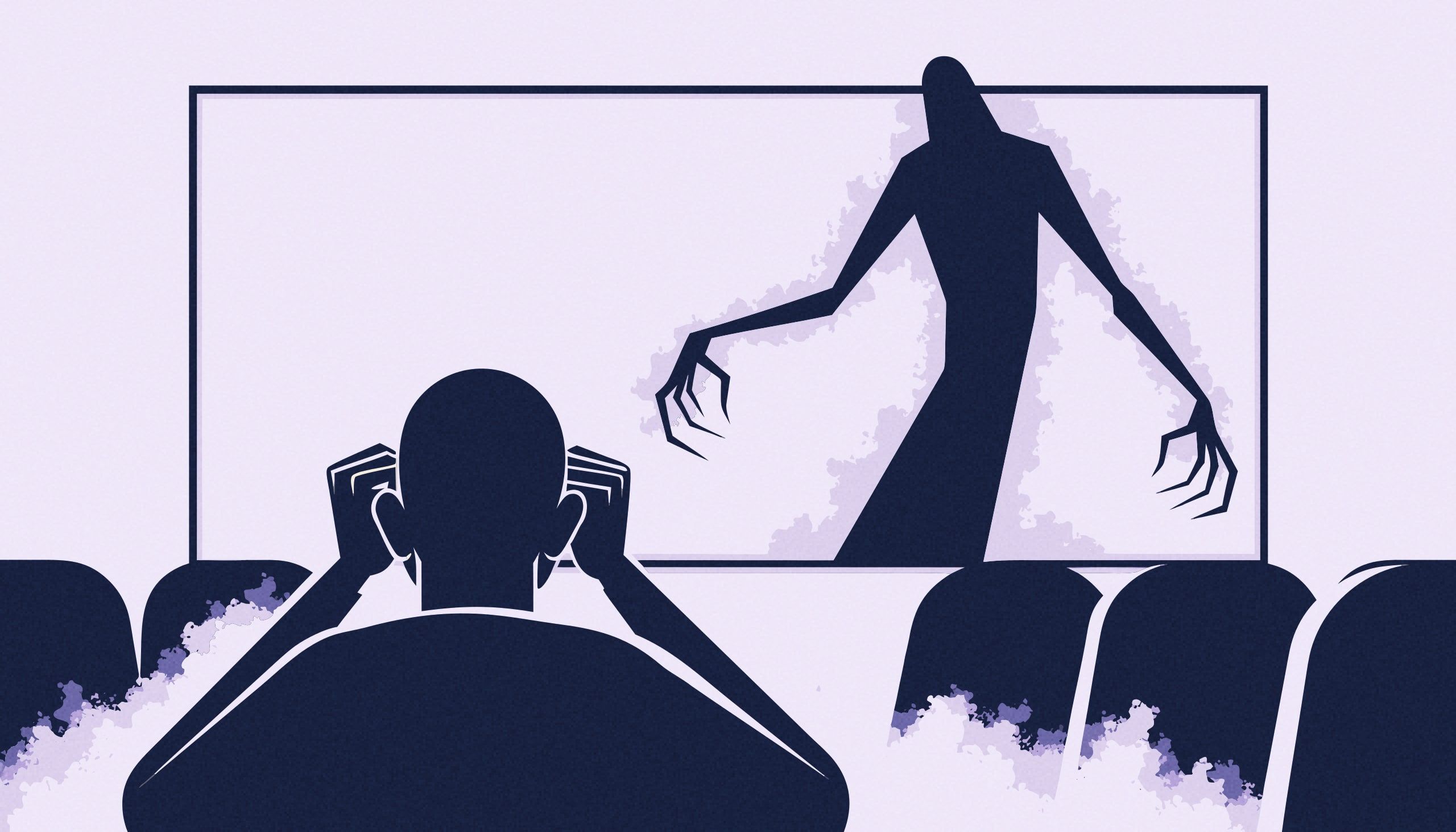
When a figure lurches out of a dark corridor, the heart races and blood pressure climbs within seconds, driven by the sympathetic nervous system. The adrenal glands release adrenaline and noradrenaline. A second pathway, slower, raises cortisol levels in the blood several tens of minutes later.
This response is not symbolic. In a Danish haunted house open in autumn for the Halloween season, researchers fitted 92 visitors with heart-rate monitors: large fluctuations in heart rate track linearly with self-reported fright. Watching a horror film, a team in Leiden measured a rise in factor VIII, a clotting protein, in 21 volunteers: +11.1 IU/dL on average compared with a documentary. No actual clotting occurs, but the concentration climbs. The body reacts as though the danger were real.
Two conditions for the alarm to become pleasure
Adrenaline does not determine the quality of the moment. A 1965 experiment showed this: a comedy film and a violent film produced similar adrenaline increases in volunteers. The substance accompanies the intensity of emotional arousal, whether pleasant or unpleasant.
What turns the alarm into pleasure is, first, context. Researchers call this benign masochism: the body triggers a full alarm, but the person knows that no real threat bears down on them. The experience is chosen, framed, interruptible.
Second condition: dose. In the Danish haunted house, evaluations taken throughout the walk show that reported enjoyment rises and then falls as fear increases. Enjoyment peaks at an intermediate level of fright, then drops when fear becomes too strong or stays too weak. This relationship holds for repeated measurements taken during the experience, not for a global verdict asked at the exit.
Everyone has their own zone
That intermediate zone is not in the same place for everyone. Two studies, one with 256 American horror fans, the other with 281 visitors to a Danish haunted house, identified three profiles. Those who seek intensity for its own sake. Those who dislike the sensation in the moment but return for what they get out of it afterwards. Those who say horror helps them manage their worries.
“Sensation seeking”, often invoked to explain these differences, shows only a weak correlation (0.22) with enthusiastic horror use. It accounts for only a small part.
What remains on the way out
Researchers measured the mood of 262 adults before and after an “extreme” haunted attraction in the United States. On average, self-reported mood improves on the way out, and the gain is clearest among those who arrived already burdened with fatigue, boredom or stress. In a subgroup of around a hundred people, electroencephalogram recordings taken before and after reveal a drop in cerebral reactivity across several test tasks, precisely among those whose mood had improved.
The authors put forward a hypothesis, in the conditional: this type of experience might reduce reactivity to subsequent stress. It is not an established fact, and even less a recommendation. But the image remains: an alarm system that, after crying out loudly into the void, settles lower than before.