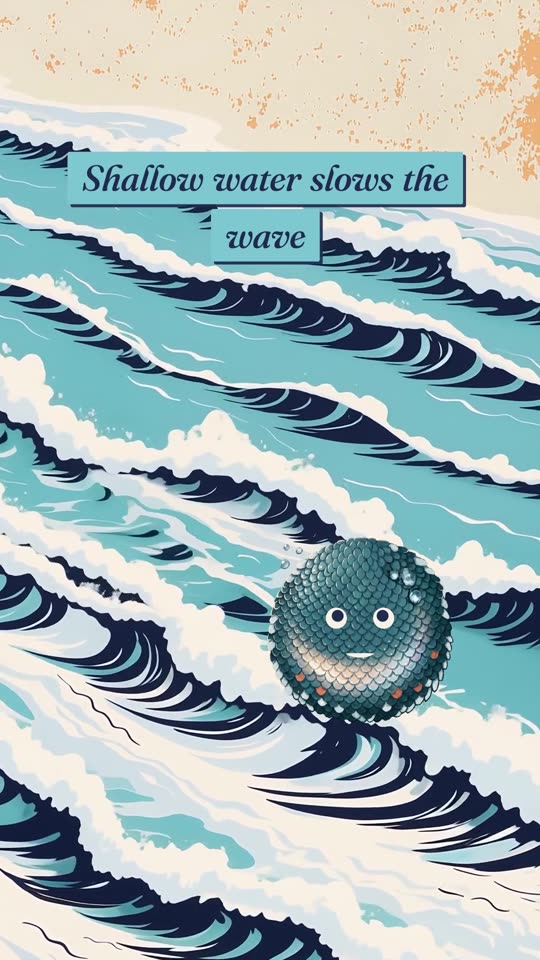
A wave slows down when the water gets shallow
Out at sea, a long swell can run at 40 km/h (~25 mph). But the moment it
nears the shore, it feels the bottom. Its speed now depends directly on
the depth: the shallower the water, the slower it goes. In physics, this
is written c = √(g·h): the speed equals the square root of the depth
times gravity. Over 10 metres of seabed, a wave moves at about 36 km/h
(~22 mph). Over 2 metres, it drops to 16 km/h (~10 mph). Over fifty
centimetres, it crawls.
Nothing stops it. It is simply held back by the seabed, the way a cart hits softer ground and drags.
When the wave comes in at an angle
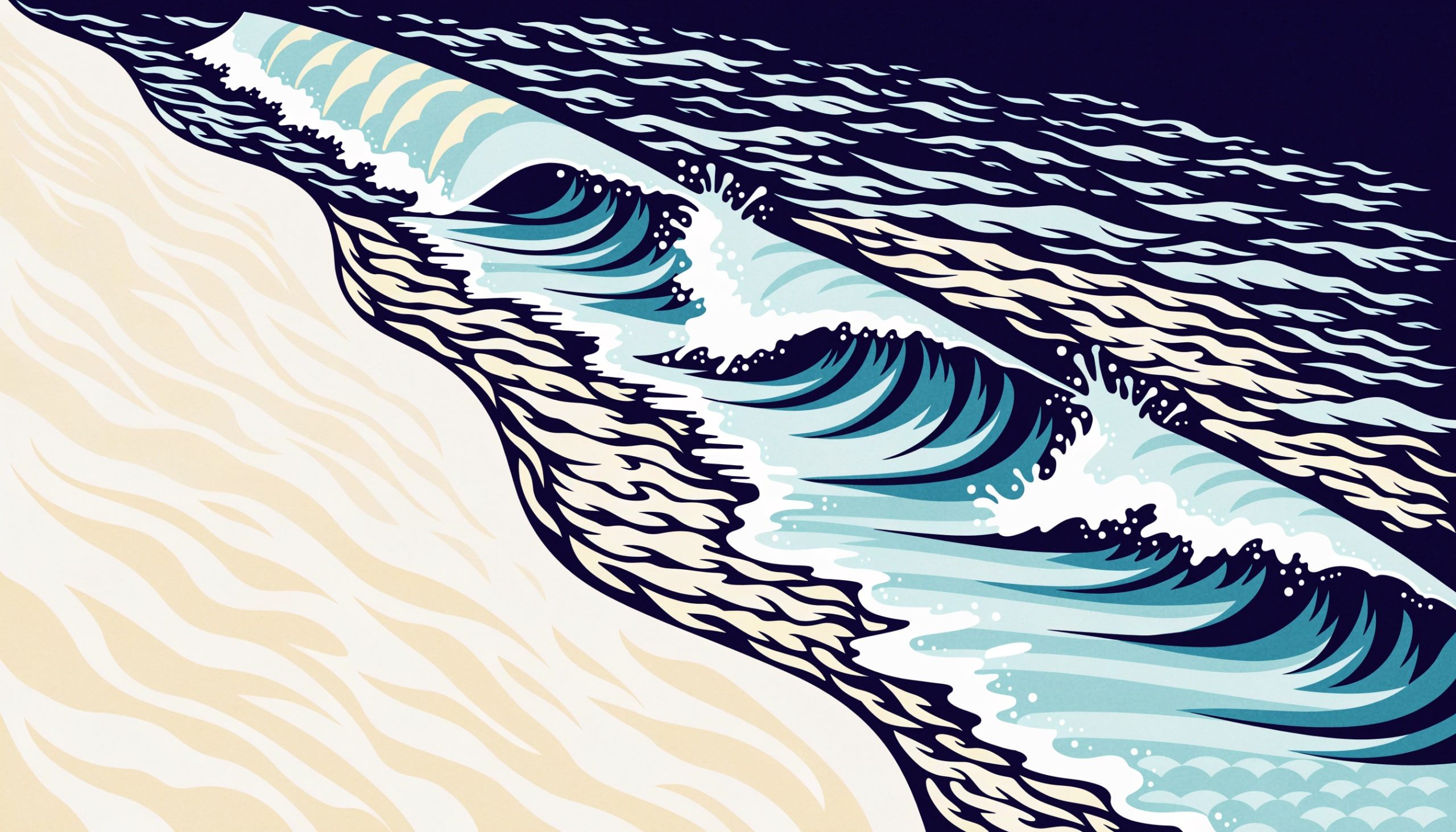
A wave is a long line, sometimes a kilometre of crest. Suppose it approaches the beach obliquely, at 30° say. The end closest to the shore enters the shallows first. That end slows. The other end, still in deep water, keeps its full speed.
The wave turns. Like a row of soldiers where the ones marching through mud lag while those on the pavement push ahead: the line pivots. It is the same optical phenomenon as light bending as it passes from one medium to another: we call it refraction.
And finally, facing the sand
As the wave keeps moving, the shallow end brakes harder still while the deeper end keeps catching up. The wave straightens its angle, then straightens again, and arrives within a few metres of the edge almost parallel to the shore — whatever the wind direction or the shape of the coast.
There are exceptions. Inside a bay, waves spread out; around a headland or a reef, they concentrate (this is what makes the good surf spots). But on a straight, even beach, the phenomenon is stubborn: the sea always arrives head-on.