Your breath runs without you
You are asleep. Your chest rises, falls, rises again. You never think about it, you never have: breathing runs on its own, like an engine left running.
For a cetacean, whether dolphin, orca, beluga or great baleen whale, that same act requires two conditions a sleeping body does not meet. First, rise until the head breaks the surface. Second, contract the muscles that open the blowhole, the nostrils sitting on top of the skull. At rest the blowhole is sealed: fibrous plugs block the passage and prevent any water from entering. It takes a movement to open it.
One hemisphere sleeps, the other keeps watch
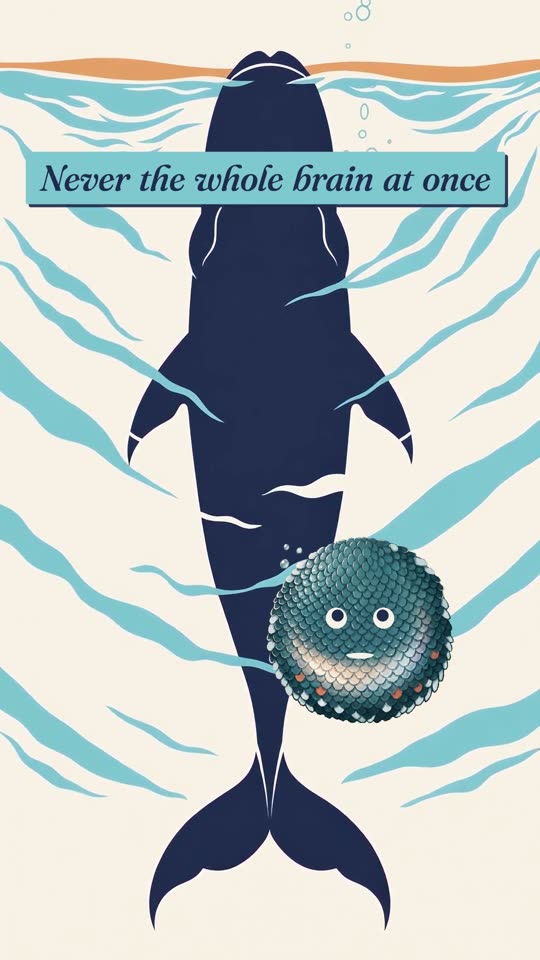
Researchers have placed electrodes on five species of toothed whale: the bottlenose dolphin, the harbour porpoise, the Amazon river dolphin, the beluga and the pilot whale. What they measured: one hemisphere generates the slow waves of unihemispheric sleep while the other shows waking activity. Then the roles reverse. Over several days, each half gets its share. In the bottlenose dolphin, an episode lasts on average 42 minutes, sometimes up to 132.
The sign is visible from outside. The eye that closes is most often the one on the side opposite the sleeping hemisphere. The other stays open and functional: a stimulus presented to that eye triggers a startle, an acceleration. Two drowsy dolphins swimming side by side each keep open the eye facing their companion. A three-month-old calf, during its rest phases, points its open eye towards its mother 95 to 99% of the time.
Sleeping while moving
In dolphins and the beluga observed at the surface, this sleep does not entirely freeze the body. Dolphins with one hemisphere asleep tend to circle slowly, always in the same direction. While floating, they use their tail and fins to stabilise their position. The smaller species, harbour porpoise and Amazon river dolphin, never pause at the surface for more than a few seconds.
During this sleep, pauses between breaths rarely exceed four minutes in a pool. A single bottlenose dolphin has been observed resting on the bottom, one hemisphere asleep, in episodes of 150 to 212 seconds, interrupted by a trip to the surface.
Two trained bottlenose dolphins, in a pool, maintained acoustic vigilance for five consecutive days without showing any sleep deficit. Their responses slowed at night, between 21
and 04, the hours when they would normally have slept. One of them, a 30-year-old female, then sustained an echolocation task for fifteen days in a floating enclosure, with no drop in performance. The authors suppose she was sleeping with one hemisphere during the task, but without any brain measurement to confirm it.The great whales: what we do not know
Electrodes have only been placed on toothed whales, in captivity. As for baleen whales, the giants you probably picture when you hear the word, no recording of their brain activity exists.
At sea, bowhead whales and minke whales are often reported floating motionless at the surface. A humpback whale fitted with a camera in Norway showed, over one hour of recording, slow dives, passive drifting at an average depth of 11 metres, which the researchers interpret as rest. Four Bryde’s whales, in New Zealand, showed long periods of low activity interpreted as rest, only at night. Some researchers consider it probable that these animals experience sleep comparable to that of dolphins, but no one has measured it.
Giants suspended beneath the surface
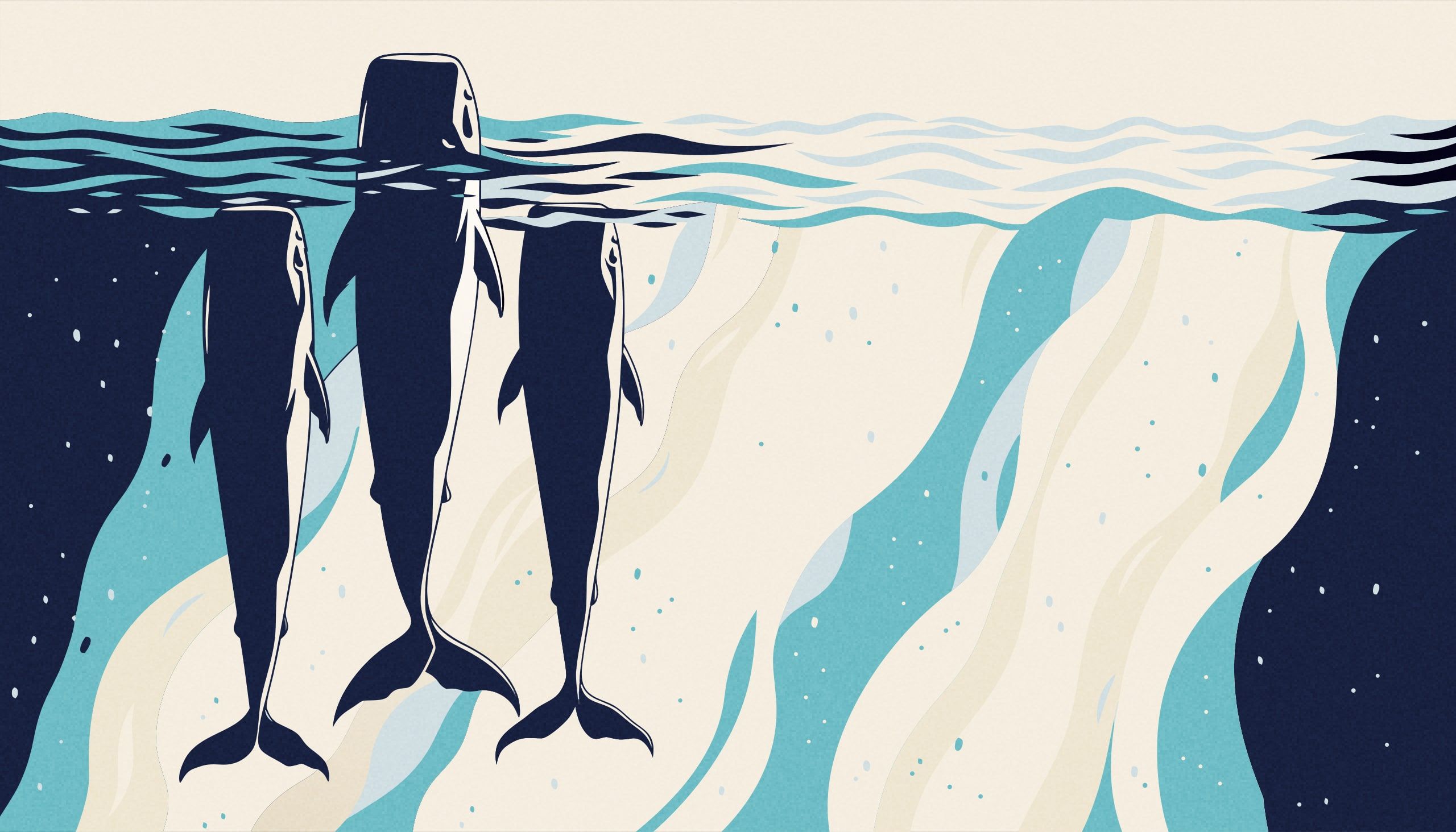
In the open ocean, sperm whales carrying tags drift vertically, just below the surface. Motionless for up to 32 minutes, head up or head down, between 10 and 20 metres deep. Not a single echolocation click. These drifting dives account for 7.1% of recorded time. Off the coast of northern Chile, three sperm whales drifting vertically did not react to a boat passing by, until it accidentally touched one of them.
Dolphins and the beluga sleep while moving, one eye open, almost without stopping. Here it is the opposite: complete stillness, silence, no response. This state occupies only a small share of their time. Are they truly sleeping, and if so, with both hemispheres or just one? The authors of the study propose bilateral sleep as a hypothesis. Sleep specialists reply that nothing proves it: no electrodes, no observation of the eyes.