A blue shape that seems inert
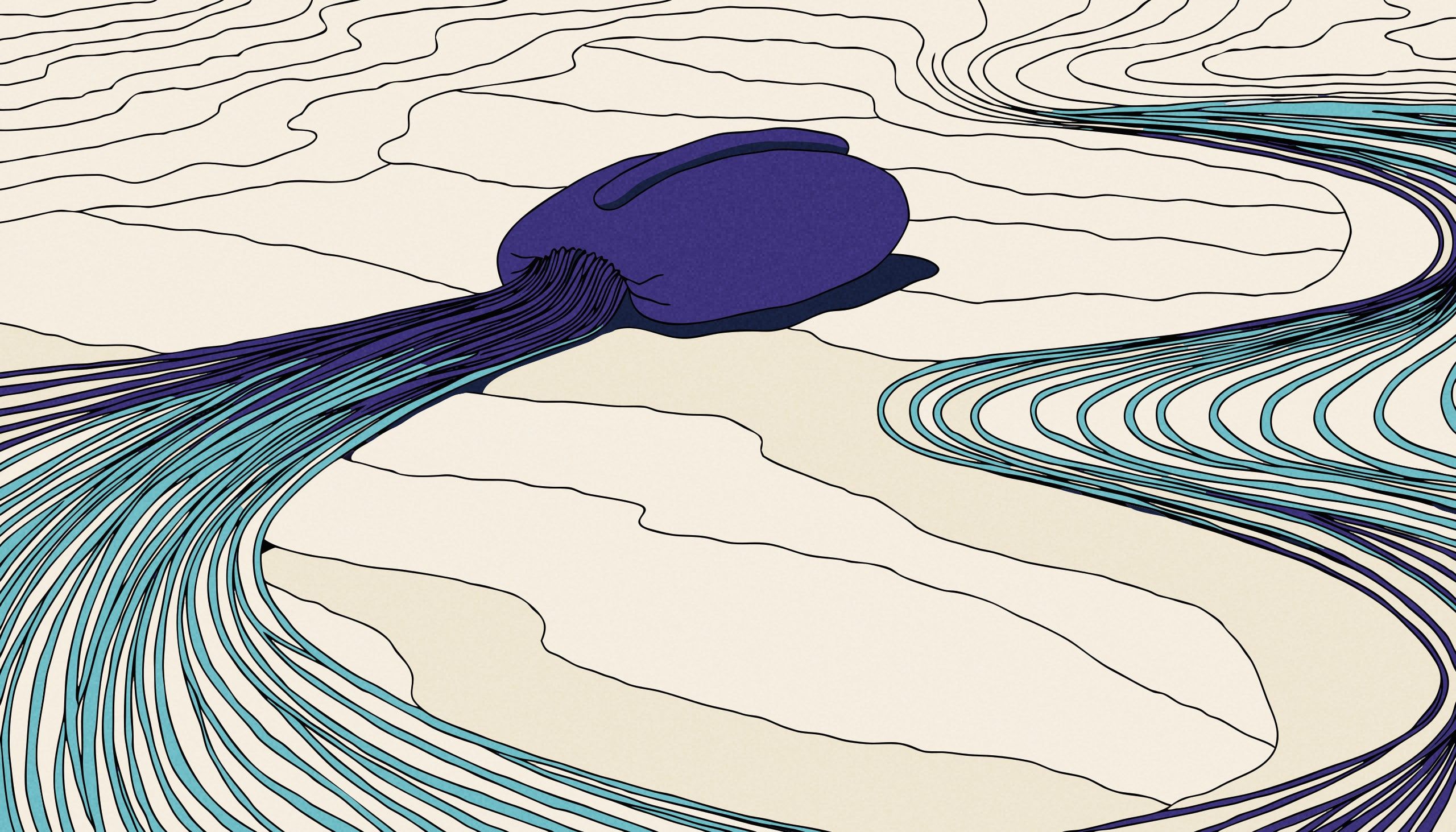
Late summer. On wet sand, a blue-violet bladder gleams like a deflated balloon. No movement, no sound. The object looks like a plastic bag escaped from a picnic, or a piece of debris the tide forgot. A child crouches, reaches out.
The Portuguese man o’ war can sting for weeks after washing ashore. The Bordeaux poison centre documented forty stings in a single day, on one beach along the Aquitaine coast, in 2008: each time, walkers touched what they believed was inert.
Not a jellyfish, a colony
A trap armed before any contact
The sting does not come from a decision. It comes from a cell.
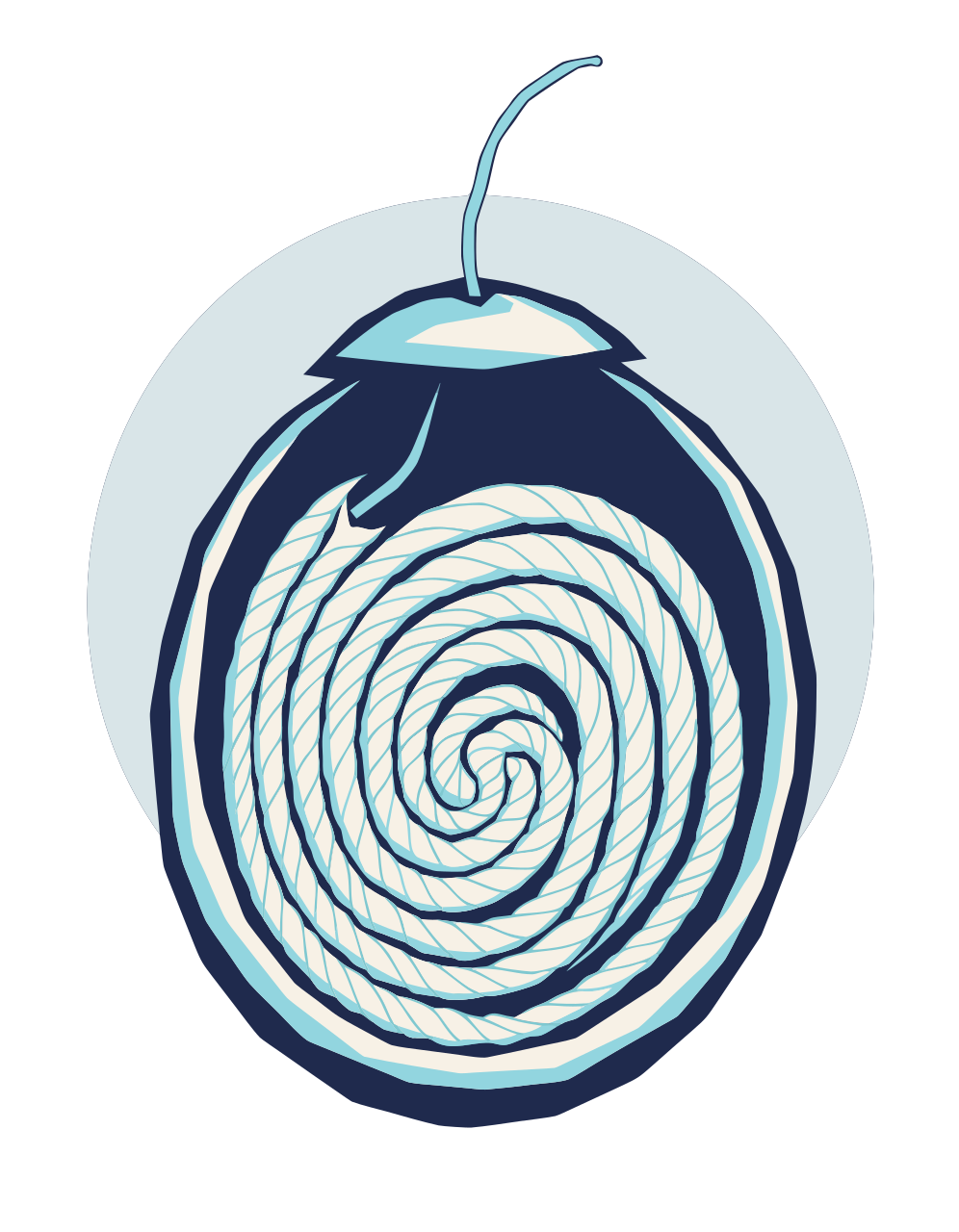
Each tentacle is covered in cnidocytes, cells that each contain a microscopic capsule: the nematocyst. Inside, a hollow barbed filament, coiled inside-out, waits. In a freshwater relative of the Portuguese man o’ war, researchers measured roughly 150 bars of osmotic pressure inside this capsule. For scale: a car tire inflates to 2 or 2.5 bars. The collagen wall, stretched to its limit, stores this energy like a drawn spring.
Two signals command the discharge: a touch-sensitive cilium and chemical receptors that detect substances released by skin or by prey. In sea anemones, researchers showed that chemistry sets the threshold and touch triggers the firing. Everything happens inside the cell. No brain, no order from elsewhere.
The discharge, measured in that same freshwater relative, was observed to last as briefly as 700 nanoseconds, with an acceleration of 5,410,000 g. At impact, pressure exceeds 7 gigapascals, on par with certain firearm projectiles. Enough to pierce the shell of a small crustacean. This mechanism equips all cnidarians, including the Portuguese man o’ war.
Sand changes nothing
Beaching disarms nothing. The energy is already there, stored in each capsule long before any contact. No one commands the firing. Torn tentacle, dying colony, blue bladder resting on sand: the capsules stay armed as long as they remain intact and moist.
The float of the Portuguese man o’ war, inflated with gas, carries a muscular crest that acts as a sail. Two mirror-image forms exist, crest facing one way or the other, a trait fixed early in development. When a sustained wind blows in one direction, it pushes more of the colonies whose sail faces that same way toward shore, hence the mass arrivals that surprise bathers.
After the drift
The colony drifted, carried by winds and currents, never choosing its route, and its journey ends on a grain of sand. But its traps do not know the journey is over. They wait. As they have always waited: armed and indifferent to the life or death of what carries them.
Look without touching. Even if the blue shape looks long dead.