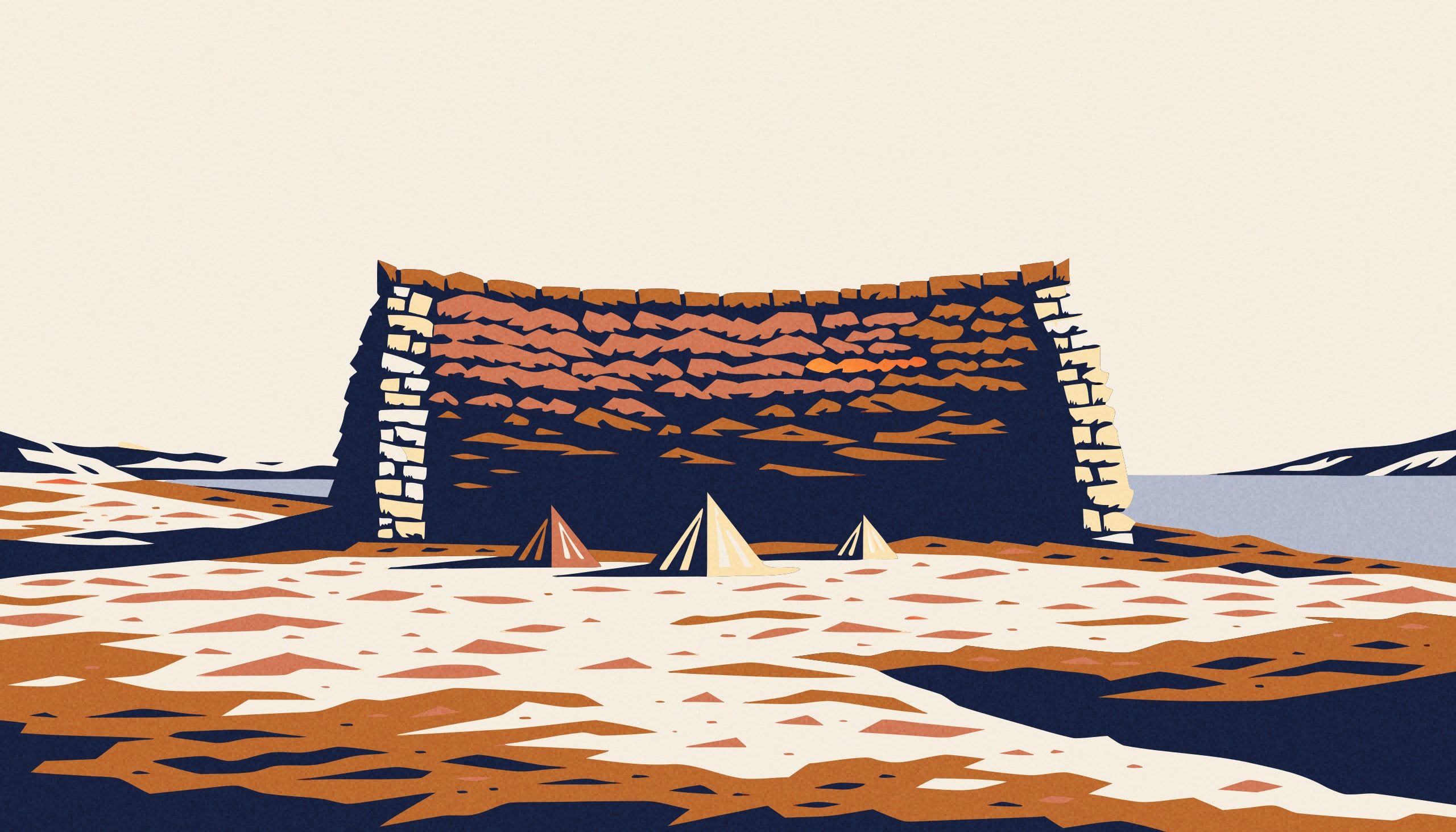
A camp at the edge of the world
In 1960, a Norwegian couple cut into the turf of Newfoundland. Underneath: compacted sod foundations, iron rivets of unmistakably Scandinavian design. Helge Ingstad and his wife, archaeologist Anne Stine Ingstad, had just uncovered what historians had hunted for decades. Europeans had built walls in North America long before 1492. The site of L’Anse aux Meadows holds eight structures: three dwellings, a forge, and four workshops, spread along the shore of Epaves Bay.
In 2021, a study published in Nature sharpened the timeline. Wood found on the site was cut in AD 1021, pinpointed through the trace of a solar storm locked inside tree rings. That puts it 471 years before Columbus.
So how did sailors from northern Europe end up there, with no magnetic compass, no printed chart, no sextant?
Stepping stones across the Atlantic
The voyage did not begin on open water. Vikings moved west in stages, generation after generation, each landfall becoming the launchpad for the next.
Iceland first, settled around 870. Then Greenland, where Erik the Red arrived circa 985 after being banished from Iceland for killing a man. Exile turned into conquest. His son, Leif Erikson, heard talk of coastline glimpsed further west. According to the Saga of the Greenlanders, a navigator named Bjarni Herjólfsson had skirted those shores without stopping, and Leif bought his ship to retrace the route. The Saga of Erik the Red tells it differently: Leif stumbles on the coast by accident. The two accounts contradict each other, yet both place Leif in America.
Around the year 1000, he reaches wooded, fertile shores. He calls them Vinland. The name is often translated as “land of the vine,” but the true meaning remains contested: some scholars read a reference to wild berries rather than grapes, others to lush meadows, depending on whether the Old Norse word vín (long vowel) means “wine” or vin (short vowel) means “pasture.”
Sailing by skin and stars
Medieval Scandinavia had no compass. Yet Viking sailors read the sea the way others read a map. They watched water colour, the bearing of deep swells, the flight paths of seabirds. They tracked the sun. A disc fragment found in Greenland (the Uunartoq disc) is sometimes interpreted as a navigation sundial, though other researchers dispute that reading. And the famous sunstone? A crystal of Iceland spar, theoretically able to locate the sun through overcast skies by polarising light. Appealing hypothesis, but no sunstone has ever been recovered from a Viking site.
What they did have was favourable geography. Norway to Iceland. Iceland to Greenland, roughly 1,200 km. Greenland to Newfoundland, roughly 1,700 km. No single crossing exceeded 2,000 km of open sea. Currents and prevailing winds at those latitudes pushed west. This was not blind courage. It was incremental navigation, built on knowledge passed down by word of mouth over generations.
Why did we forget?
The settlement at L’Anse aux Meadows did not last. The Icelandic sagas, prose narratives composed in the 12th and 13th centuries, describe clashes with local peoples the Vikings called Skraelings. Too few settlers, too far from supply lines, too dependent on difficult resupply from Greenland. The site appears to have served for a handful of years, possibly as a seasonal camp rather than a permanent colony, before being abandoned.
And here the story splits. Columbus arrives in 1492 under entirely different conditions: the printing press, barely forty years old, is connecting Europe’s literate classes; Iberian kingdoms are bankrolling expansion; trade routes need new outlets. His voyage opens a lasting link between two worlds — Leif’s did not have the means to hold.
The gap between discovering a place and changing the world is not just a matter of who got there first. It hinges on what you can build once your boots touch the ground.
Being first isn’t enough to leave your name behind. A forgotten pilot, turned despite himself into the name of a stadium, knows something about that. Why is Roland-Garros named after a pilot?