A code that dropped from the sky (or the screen)
A nine-year-old walks home from school, backpack half-zipped. Someone asks how recess went. He shrugs: “It was 6-7.” Silence. Confused adult stares.
To him, the phrase is as natural as “meh” or “whatever.” To them, it’s a code that didn’t bother knocking before barging in. Behind those two numbers, an entire generation is crafting its own language in a matter of weeks, quietly, just below the radar.
Where does “6-7” actually come from?
It starts with a song. Late 2024, American rapper Skrilla, from the Kensington neighborhood of Philadelphia, uploads a track called Doot Doot (6 7). The track circulates informally at first, before an official release in February 2025. His style blends Philadelphia drill with Detroit-inspired production. In the chorus, Skrilla chants “6-7” over a beat that sticks in your head. The song first pops up in basketball edits on TikTok, especially around LaMelo Ball, point guard for the Charlotte Hornets, who stands 6 feet 7 inches tall (2.01 m, per his official NBA profile). Viral clips pair the player’s height with Skrilla’s chorus, and the connection catches fire. From there, the sound explodes on TikTok, then jumps to Instagram Reels and YouTube Shorts.
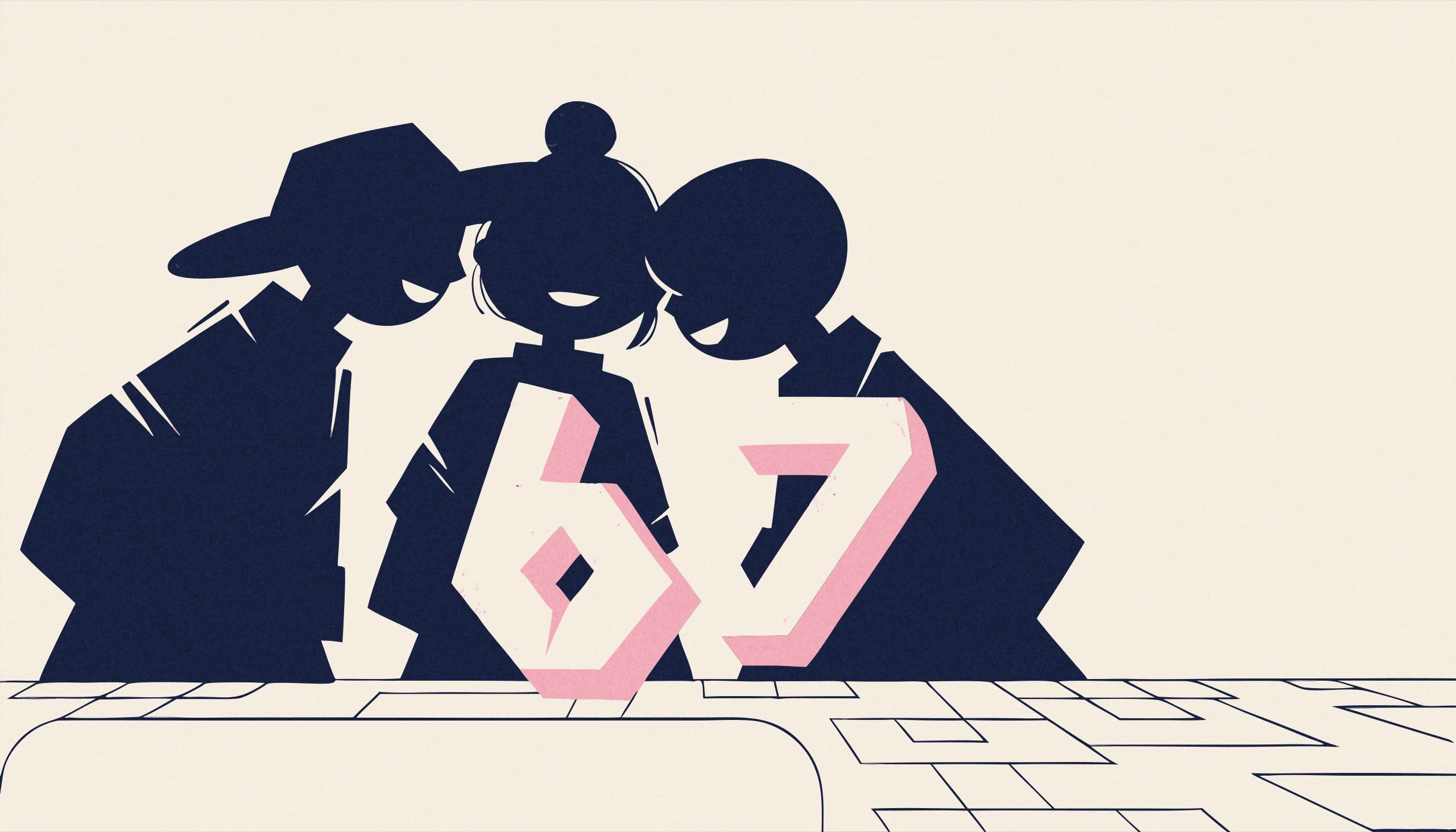
The phrase has no fixed meaning. Not “whatever,” not c’est la vie, not “somewhere in between.” A bit of all that, or nothing at all: it depends on context, mood, tone. Some kids chant it in a loop with an open-palm hand gesture, just because it’s fun to say. Absurdity is the engine.
The number itself refuses to settle. Some link it to 67th Street in Philadelphia, a neighborhood tied to Skrilla. Nobody settles it. That’s precisely what keeps it alive: everyone pours their own meaning into it.
Why kids, and not adults?
Gen Alpha (children born from 2010 onward, per Australian researcher Mark McCrindle) is the first generation that doesn’t remember a world without short-form feeds. TikTok, Reels, Shorts: these aren’t formats they discover. They’re part of the house. A wall. A piece of furniture.
In this habitat, expressions travel at a speed adults can’t track. A sound, a phrase, a filmed gesture can be copied by hundreds of thousands of kids in days. And because the algorithm serves content based on behaviour, those who watch the same videos end up exposed to the same word, at the same moment, everywhere. One detail matters: TikTok is officially off-limits to under-13s in most countries, but many bypass age checks, or catch the trend through reposts on YouTube Shorts and Instagram Reels.
Parents, meanwhile, scroll through a different feed. Even an active parent’s TikTok account might never see this content: the algorithm quickly learns to show something else. The code seems to appear “out of nowhere.” Except it comes from a very specific place. A place invisible to anyone who doesn’t have an account there.
A language built for belonging
Why do kids latch onto these phrases so fast? Not just because they’re funny or handy. They work like passwords. Say “6-7” to someone who doesn’t get it, and you’ve quietly drawn the boundary of the circle. Say it to someone who answers “yeah, totally” or just smiles, and you’ve crossed a threshold. You’re in the same space.
This isn’t new, just ask April Fools’. Teenagers in the 80s had their own slang, and so did the 90s. What’s changed is scale and speed: the peer group no longer fits inside the classroom or the neighborhood. A kid in Manchester can share the same references as a kid in Toronto or Melbourne without ever meeting.
Belonging used to mean the block, the class, the playground. Now it’s the feed.
What “6-7” tells adults
Nothing alarming. Viral phrases like this aren’t a sign of language decay — they’re proof it’s alive. Kids aren’t replacing words with “6-7.” They’re adding a tool to their kit, one calibrated for their social space.
Many adults, when they catch a code they don’t understand, see danger. The reaction is old. Hip-hop slang triggered the same alarms in the 80s and 90s as its words leaked into the mainstream. UK street slang did the same in the 2000s. Those languages survived, evolved, and some of their words (diss, vibe, lit) eventually made it into the dictionary.
“6-7” took a stranger turn, though, and we’ll get to it. Gen Alpha will have moved on to something else long before, either way. But what the kid says is almost never what the numbers say. The translation matters less than the intention. And the intention, nine times out of ten, is simply: we’re fine, we’ve got it, six-seven.
Mid-2026: the word grew up, the kids moved on
In late October 2025, Dictionary.com named “67” its word of the year, stating plainly that the expression is “impossible to define.” The nonsense had become the official definition. From there it spilled out everywhere: schools banned it in class, and the In-N-Out burger chain quietly pulled order number 67 to stop the noisy celebrations it triggered.
And that is roughly what killed it. By early 2026, teenagers were already calling it dead. The moment adults, brands and institutions know the password, it no longer marks the edge of any circle. When Pope Leo XIV himself sketched the gesture in front of young Catholics at the Vatican, in May 2026, in a video watched more than twenty million times within days, it looked less like a coronation than a posthumous tribute. The phrase lingers a little longer among younger kids, but the older ones have already moved on. A word of belonging doesn’t die of old age. It dies when everyone understands it.