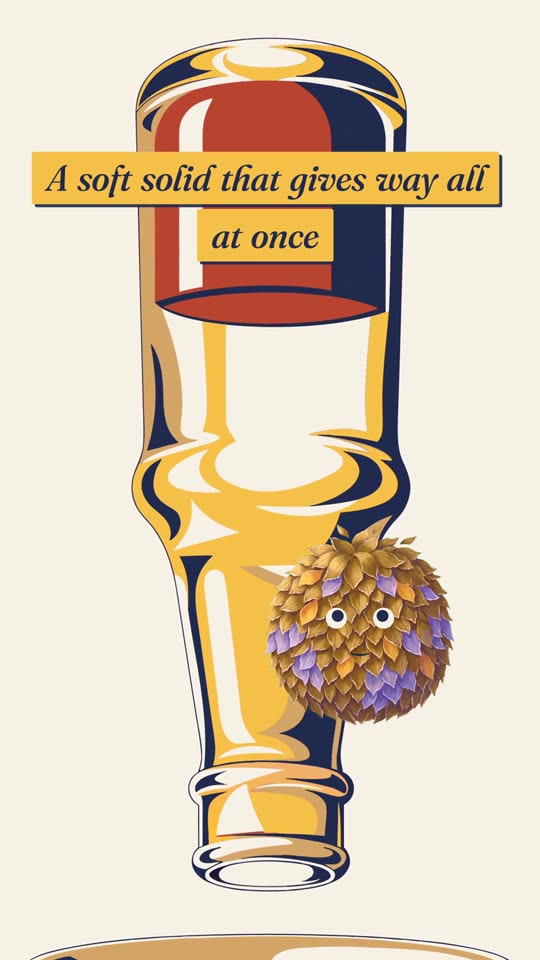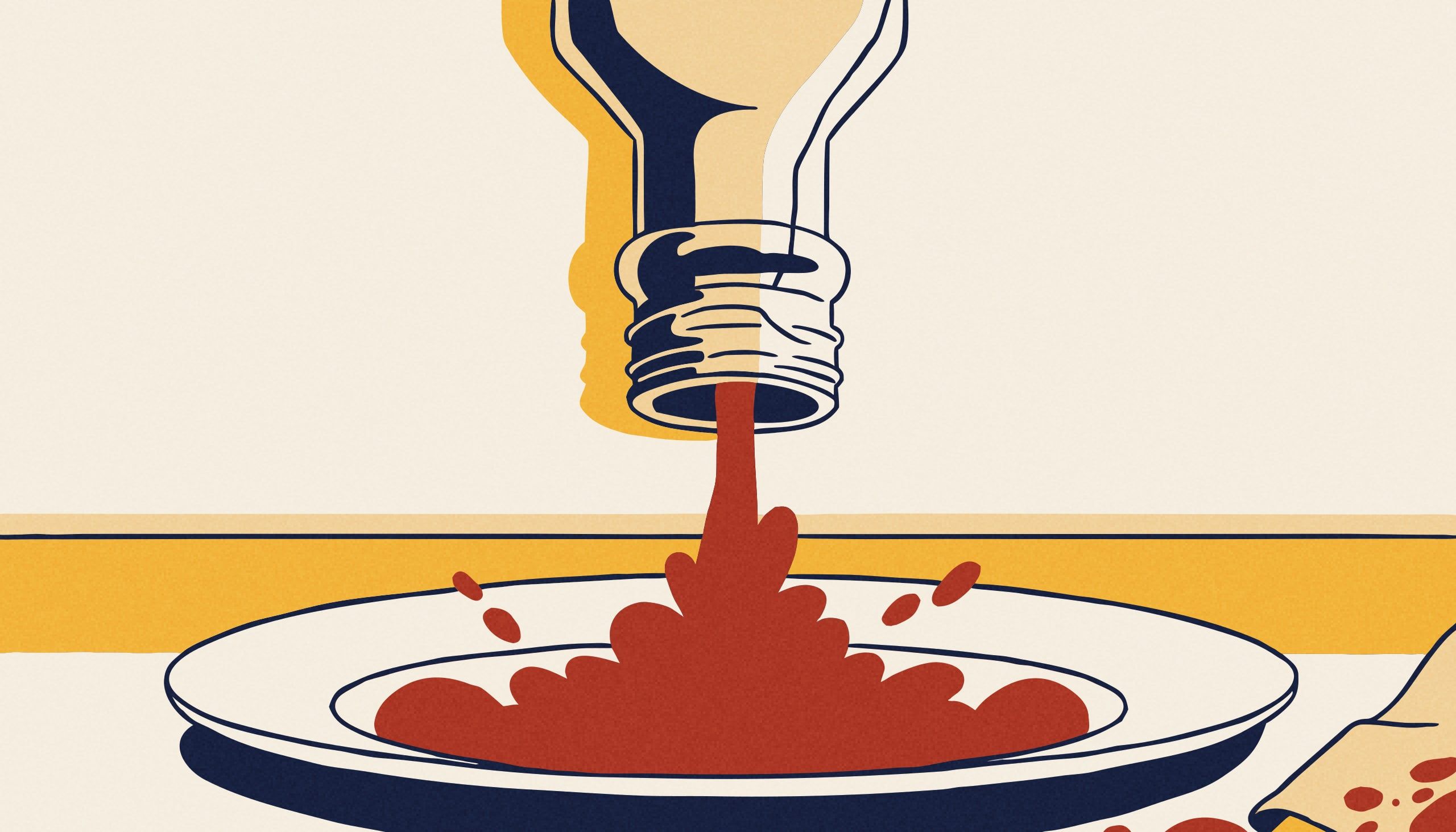
You turn the bottle, and nothing comes out
The scene is universal. You invert the bottle over your plate, you wait, you tilt it further, you tap the base. Nothing. Then you give it one hard shake, and the sauce erupts in a single gush far beyond what you wanted.
This behaviour is not a packaging flaw. It follows from the very nature of the product, which researchers in rheology (the science of flow) have measured with precision instruments. Ketchup does not belong to the family of liquids. It belongs to the family of yield-stress fluids, materials that behave as solids until you force them hard enough.
Neither liquid nor quite solid
To understand the difference, compare it with honey. Most liquid honeys are what physicists call Newtonian fluids: their viscosity depends on temperature, not on the gesture. Honey flows under gravity, however slowly. It has no threshold to cross.
Ketchup, by contrast, has a yield stress. Below that force value, the flow rate is exactly zero. Not low, not slow: zero. Measurements on a commercial ketchup at 23 °C, taken with a controlled-stress rheometer, give a threshold of 13.0 ± 2.2 pascals. The pascal is the unit of stress, a force divided by an area. This value depends on the product, the temperature and the method: a control ketchup prepared in the laboratory, measured at 25 °C in a separate study, gives a result three times lower.
Once barely moving, that same ketchup shows an apparent viscosity of 80 to 100 Pa·s, roughly one hundred thousand times that of water. But that figure describes only the material already in motion. At rest, it simply does not flow.
A network that holds, then breaks
Ketchup is a concentrated suspension: fragments of tomato cells and pectins dispersed in an aqueous liquid. When the bottle sits still, these elements assemble and weave a network that fills the entire volume. It is this network that gives the product its soft-solid structure.
Invert the bottle and wait. The only force at work is gravity acting on the mass of sauce. That stress can remain below the threshold, especially if the bottle is nearly empty or the product has rested for a long time: nothing comes out.
When you shake, the force exceeds the threshold and the network breaks. The material becomes shear-thinning: its viscosity drops as the motion accelerates. The transition from zero flow to easy pouring happens with almost no intermediate state. That is what explains the excessive gush.
After the gesture, the structure rebuilds itself gradually during rest. Not instantly. So the second pour remains too easy, and after a long period untouched, the blockage returns.
The gestures that work
Anthony Stickland, a researcher at the University of Melbourne, published a three-step protocol. First, shake the bottle vigorously with the cap on to break the internal structure. Then, still with the cap on, give it a sharp downward motion followed by an abrupt stop, to drive the sauce into the neck. Finally, open and tilt to around 45 degrees. If nothing comes, tap the base gently and increase the force gradually, staying just above the threshold.
Heinz, for its part, recommends a firm tap on the embossed “57” at the neck of its glass bottle. The manufacturer advises it, but no scientific publication has validated the technique. As for the 45-degree angle, a Canadian advertising campaign by the brand presented it as the ideal pouring angle: a convenient reference that aligns with the researcher’s recommendation, but with no measurement protocol behind it.
The slowness is deliberate
You are trying to get the ketchup out faster. The manufacturer, meanwhile, claims a maximum speed for its product. According to Kraft Heinz, ketchup must flow at less than 0.028 miles per hour, roughly 1.25 centimetres per second. This figure is obtained on a test ramp inclined at 45 degrees over a 20-centimetre course, built for the purpose. The brand presents this slowness as proof of quality.