The sharing no one chose
A small wireless microphone hidden in the colourful straps holding up the children’s trousers, two children free to move about a house, a parent listening from the next room. The parents were told the study was about play. The microphone was recording something else.
In the late afternoon, when tiredness and hunger build, clashes pile up. Averaged across all the families, the count is about 2.6 conflicts per 45-minute session, each lasting about 45 seconds on average. Intensity stays between low and moderate; physical exchanges are rare. This figure is a floor: it only counts exchanges where the opposition lasts several turns. Briefer clashes fall below the threshold.
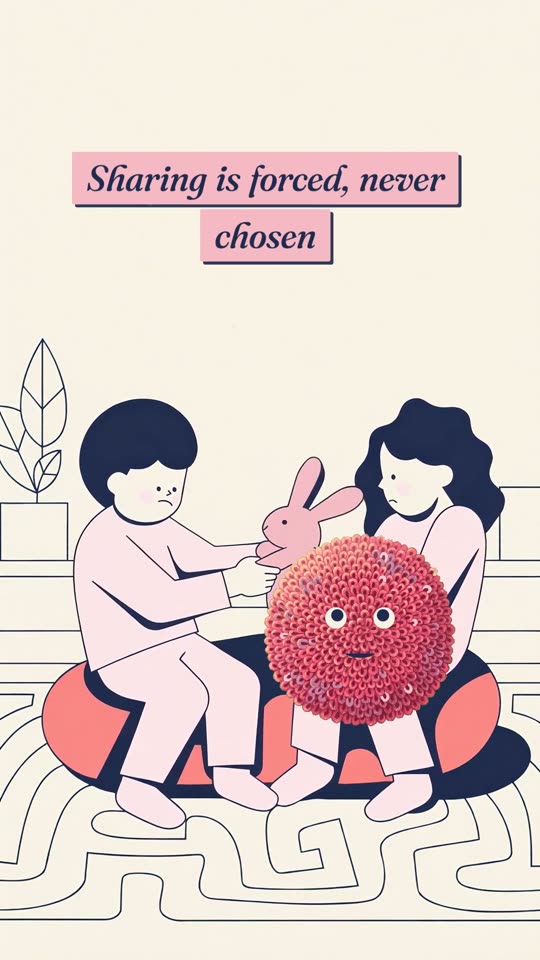
Beneath these disputes, a simple fact. Two children share the same objects, the same space, the same meals, the same schedule, without having decided to. Among toddlers, before primary school, disputes over objects offer a clear illustration. Two rules collide: ownership, who the object belongs to, and possession, who has it in hand. Ownership wins in the arguments and in the outcome. Parents, for their part, back neither rule clearly.
The mismatch written into the demand
Behind the objects and the space, another resource is shared: the parents’ time, care and attention.
According to a model from evolutionary biology proposed by Robert Trivers, each offspring is inclined to demand slightly more care than the parent is inclined to give. The disagreement is structural: it concerns the amount and duration of care, and it deepens over the period when the parent feeds and protects. The model also predicts a disagreement over the share the offspring leaves to its kin.
With two children, the reading is direct: two demands, each set a notch above the parent’s offer, fall on the same source. According to this model, the friction is written into the very structure of the demand.
This framework rests on data gathered from mammals, consistent with its predictions. No measurement in children has confirmed it: it is a model, not a proof.
Quarrels and intimacy at a small age gap
When the age gap between two children narrows, reported quarrels increase. The threshold sits at about four years: below it, children and adolescents report more conflicts with their sibling. But they also report more intimacy. The two rise together, in the same child.
This is an association, not a cause: it is a comparison between groups at one point in time, and it is not possible to say whether the gap produces the quarrels or whether some other factor produces both.
Shared life loosens
From the start of the older sibling’s adolescence, sibling conflict falls. The older and the younger child pass through this decline in the same period, at different ages.
Separately: from childhood to late adolescence, time spent together decreases steadily. With an older sibling, quarrels decline gradually over these years. With a younger one, they stay level.
One possible reading connects the two: disputes arise from this imposed sharing, the same roof, the same toys, the same adults, the same hours, everything held in common without being chosen. When shared life loosens, disputes follow. This is a reading, not a measured result.
The decline in disputes says nothing about the bond. The bond escapes this mechanism.