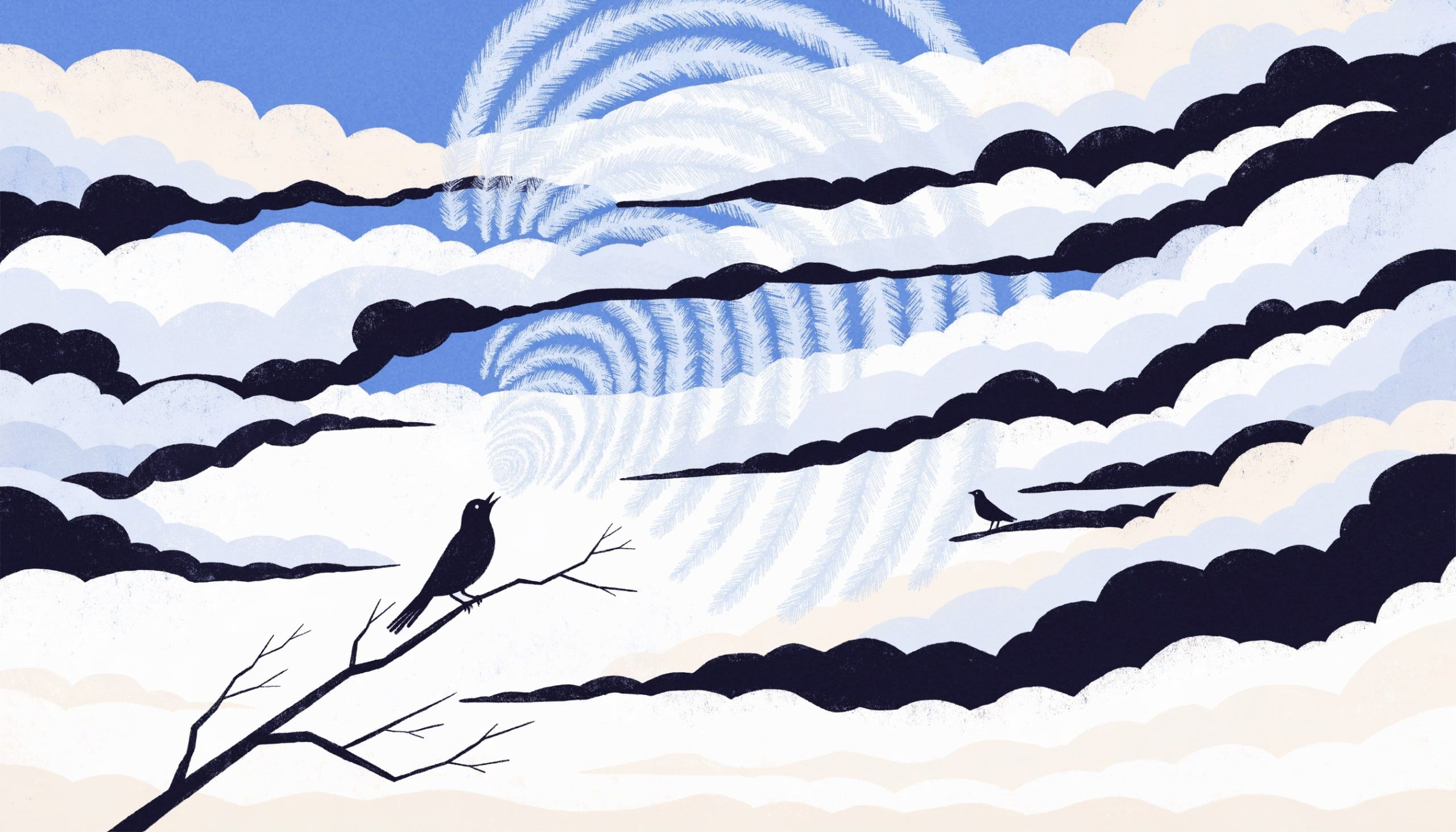
Before the sun is even up
The phenomenon has a name: ornithologists call it the dawn chorus. It usually begins half an hour to an hour before sunrise, peaks right at the edge of daylight, then fades as the morning settles in. It is most spectacular in spring, during the breeding season. And among most European songbirds, it’s the males who do the singing.
So why this hour, when birds are quieter the rest of the day? Several reasons stack up, and they all pull in the same direction.
Who sings first?
Not every bird starts at the same minute. The chorus follows a fairly steady order: in Europe the robin often opens, closely followed by the blackbird, while blue tits and chaffinches may not join until an hour or more later. The reason is in their eyes. The bigger a bird’s eye, the more of the dim dawn light it gathers, and the earlier it dares to sing: the robin’s large eyes let it see, spot a predator and start up while it’s still almost dark. Small-eyed species wait for the day to feel a little safer.
Cold air is an excellent messenger
At dawn the wind is almost gone, the leaves are still, the temperature holds steady. Sound travelling through that kind of air carries much further than through the noise and turbulence of midday. Older estimates put the gain at ten- or twentyfold, though recent work (Cornell Lab, 2025) suggests this acoustic edge weighs less in the decision to sing than long assumed. Either way, for a bird whose goal is to be heard by as many of its kind as possible, dawn is a privileged window.
The light, meanwhile, is still too thin for insect hunting to pay off: prey are hard to spot, often sluggish with the cold. The trade-off falls into place on its own: sing first, eat later. Once the sun is up and the air warms, the insects stir, and the birds switch over to foraging.
A contest for survival
Singing is costly. It’s loud, it burns energy, it draws predators. A male who sings hard and long is sending an expensive message, and for that very reason, a credible one: I’ve done well enough in life to afford this display.
Females are listening. Several studies have shown that they read a male’s vigour, health and experience off the quality of his morning song. Rivals, for their part, use the chorus to map territories: who’s still singing, who’s gone quiet, who holds which hedge. It’s a daily bulletin on who’s thriving, who’s dead, who’s just moved in.
The dawn chorus, then, is at once a local radio station, a singles window, and a territorial security report. All of it run, free of charge, by birds — forty minutes before the first coffee.
And while some are singing, others are still asleep on their feet, one leg tucked in the warmth. Why do flamingos stand on one leg?