Two experiences, not one
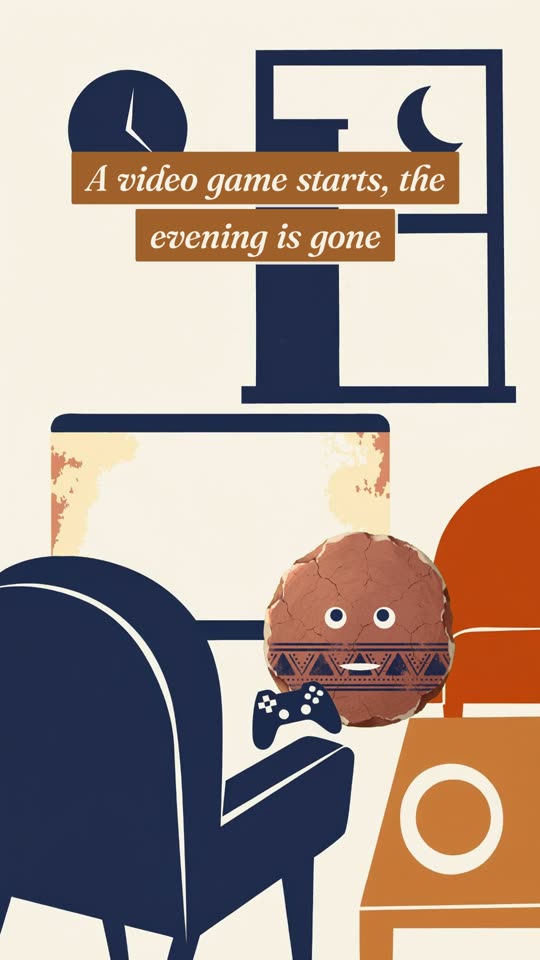
You look up. Dinner has gone cold. You would have sworn only a few minutes had passed.
This gap covers two experiences that research measures separately. The first: the sensation that time is flying or stretching during an activity, called passage-of-time judgement. The second: estimating afterwards how many minutes elapsed. In a study that compared this sensation with judgements of very short durations, the two proved largely independent.
A field study conducted in Clermont-Ferrand followed 27 people over five weekdays. Eight times a day, a smartphone had them judge sounds of about one second, warning them in advance that they were estimating a duration, then asked them how fast time was passing. Result: no statistical link between perceived speed of time and these duration judgements.
An older experiment, cited by the same authors, illustrates this gap. After an action film, the speed of time was reported as greater than after a relaxation video. But once the film was over, it was judged slightly longer than that same video. Two measures, two directions. Afterwards, it is memory that judges: a period poor in memories seems shorter.
What accompanies the felt speed
The same field study associates the sensation of fast time with two self-reported states: feeling happy, and having one’s attention captured by the current activity. In this study, the more attention was captured, the faster time seemed to pass. A correlation between self-reports, not an identified mechanism.
On the gaming side, an online survey of 280 players describes what they associate with losing track: complexity, levels to clear, scores to beat, plot, the presence of other players. The authors conclude that losing track of time figures, for a large share of respondents, among the reasons that draw them to play. The experience is lived as a release, a distancing from the everyday. Its downside exists too: things sacrificed, guilt.
A state described elsewhere
The psychologist Mihaly Csikszentmihalyi gathered from the 1970s onwards accounts of deep absorption: dancers, climbers, chess players, surgeons, across several countries. Eight components recur, the last of which is this: felt duration shifts relative to the clock.
Most say time flew. The author reports that ballet dancers can experience a difficult turn, lasting less than a second in real time, as though it stretched over several minutes. One dancer recounts that at one in the morning, it felt as though eight o’clock had been only minutes ago.
A cardiac surgeon, meanwhile, could tell the time to within half a minute without a watch. Several operations running in parallel required him to know the time at all times: his colleagues, in other rooms, relied on his punctuality.
Csikszentmihalyi leaves open the question of what role this shift plays in pleasure: a simple consequence of concentration, or an ingredient of elation in its own right? In his view, losing track of the clock is probably not an essential driver of pleasure, but it amplifies its momentum.
What retrospective measurement shows
What goes with absorption
One hundred people, a rhythm game, twenty-five minutes. The state of absorption, measured by questionnaire, went hand in hand with two things at once: fewer thoughts about time, and a greater felt speed. Separately, it also went hand in hand with a higher score. Two correlations with the same state, no established link between them and no cause in either direction.